On this page
- What is malicious compliance?
- Why do employees do it?
- The four types of malicious compliance
- Everyday examples of malicious compliance
- Malicious compliance vs insubordination vs an honest mistake
- Can malicious compliance get you fired?
- What managers can do to prevent it
- Frequently asked questions
- What does maliciously compliant mean?
- Is malicious compliance illegal?
- Is malicious compliance the same as work to rule?
- Can you be fired for malicious compliance?
- How can managers spot malicious compliance?
Quick answer: Malicious compliance is when an employee follows a rule or order exactly as written, even though they know the result will be slow, wasteful, or embarrassing. The employee does not break the rule. They obey it so literally that the rule itself causes the damage, and the flaw in the rule becomes impossible to ignore.
It sounds like a discipline problem, and sometimes it is. More often, it is a warning sign that a rule is badly written, a manager is not listening, or a team has stopped speaking up. This guide covers what it means, the four forms it takes, how it differs from insubordination, whether it can get someone fired, and how managers can prevent it.
What is malicious compliance?
Gusto describes malicious compliance as following instructions exactly as they are given, knowing the outcome will not be helpful or productive. It is not open defiance. It is obedience taken so literally that it exposes a flaw in a policy, a decision, or a process.
Three ideas sit inside the definition:
- The letter beats the spirit. The employee does exactly what the words say and ignores what the rule was clearly meant to achieve.
- The outcome is expected. The employee can see the problem coming and goes ahead anyway. That foresight is what makes it malicious rather than careless.
- There is cover. When challenged, the employee can honestly say, “I did exactly what you asked.” The rule becomes a shield.
You will also see people described as maliciously compliant, which means the same behaviour from the person’s side. The idea is closely related to work to rule action, where staff do only what their contract or rulebook requires and nothing extra. Malicious compliance is usually smaller and more personal: one employee, one order, one predictable bad result.
Why do employees do it?
Nobody starts a new job planning to weaponise the rulebook. Indeed for Employers notes that employees often turn to this behaviour after trying to raise a concern in the normal way and feeling that their view was disregarded. The common triggers are:
- Micromanagement. When every step is controlled, employees stop using judgment. Following orders to the letter feels safer than thinking.
- Feeling unheard. A worker warns that a rule will fail, gets brushed off, and decides to let the result make the argument instead.
- Rigid or outdated rules. A policy written for last year’s team gets applied to this year’s reality, word for word.
- Constantly changing priorities. Each new order is followed exactly, including the ones that clash with the order before it, so the chaos becomes visible.
- Burnout and disengagement. Tired, checked-out staff stop questioning anything. They do what is written and nothing more.
- Self-protection. If a task looks risky, following the written instruction exactly means the blame lands on the instruction, not the person.
Notice the pattern. In most cases the behaviour is a signal about the workplace, not just about one difficult employee. That is why BambooHR treats it as a symptom of deeper issues such as poor leadership, communication failures, and overly restrictive policies.
The four types of malicious compliance
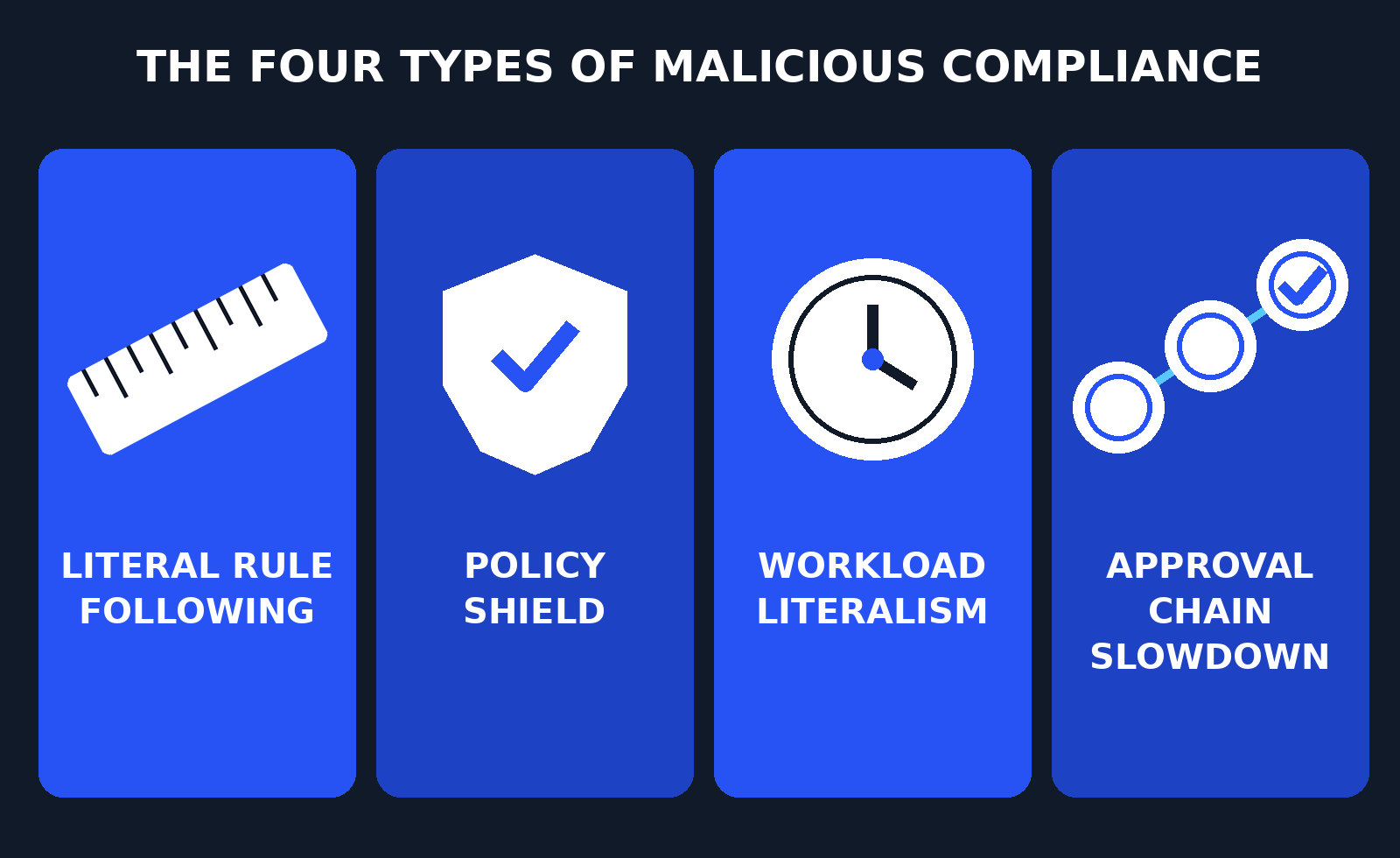
Not all malicious compliance looks the same. Sorting it into types helps a manager work out what problem the behaviour is pointing at, because each type has a different fix. This classification is our own, built from the patterns HR guides describe.
| Type | What it looks like (generic example) | The real problem it signals | The manager fix |
|---|---|---|---|
| Literal rule following | Told “no work after 5 p.m.”, a support agent closes a customer chat at 5:00 mid-sentence, every day | A rule written with no room for judgment, or a manager who punishes initiative | Add a finish-the-task exception and say judgment is expected |
| Policy shield | An employee quotes the handbook to refuse a reasonable one-off request a manager would normally approve | Staff feel rules are used against them, so they use rules back | Review the policy, publish when discretion is allowed |
| Workload literalism | A team member does only the tasks listed in their job description and lets anything unlisted wait, even when it is urgent | Role overload, unfair extra work, or a dispute about pay and scope | Rebalance the workload and agree the real scope of the role in writing |
| Approval chain slowdown | Every request waits for the full written approval at every step, even when a quick verbal go-ahead used to be normal | Staff no longer trust that informal approvals will protect them | Give a clear fast-track for low-risk requests and confirm approvals in writing |
One pattern runs through all four types. The employee is not refusing to work. They are refusing to rescue a flawed instruction with their own judgment, the way they quietly used to. Approval queues show the cost: when every step waits for its full quoted window, work takes far longer than anyone planned, a problem we break down in our guide to what business days are.
Everyday examples of malicious compliance
The scenarios below are made-up examples written to show the pattern. They are not reports of real cases.
The 5 p.m. shutdown. A team is told that nobody may work past 5 p.m., with no exceptions. One team member stops mid-task at 5:00 every day, even when five more minutes would finish a job due that evening. Deadlines slip. The rule is obeyed perfectly, and that is the problem.
The approved list. IT is told to block every website that is not on the approved list. The list was never updated, so a tool the whole office uses daily gets blocked too. Work stops until a manager fixes the list that should have been fixed months earlier.
The perfect form. A finance rule says expense claims need every field completed, including fields that make no sense for small claims. A clerk starts returning every incomplete form without a word of guidance, even forms from new starters who were never told the rules. Claims pile up, and the clerk has done nothing but follow the process exactly.
In each case, notice what is missing: a quick question, a small exception, a warning before the damage happened. Malicious compliance fills the space where that judgment used to be.
Malicious compliance vs insubordination vs an honest mistake
These three get mixed up, and the mix-up matters, because each one needs a different response.
| Malicious compliance | Insubordination | Honest mistake | |
|---|---|---|---|
| Did the employee follow the order? | Yes, to the letter | No, they refused or ignored it | They tried to follow it |
| Did they know the outcome would be bad? | Yes, that is the point | Not relevant, the refusal is the issue | No, the bad outcome was a surprise to them too |
| What is really going on? | Protest, self-protection, or a point being made | A direct challenge to authority | A gap in training, information, or attention |
| Fair first response | Ask why, then fix the rule or the relationship | A disciplinary conversation about the refusal | Coaching, clearer instructions, better checks |
Insubordination means refusing a lawful and reasonable instruction. Malicious compliance is almost the opposite problem: the instruction was followed. Treating it as insubordination is shaky ground, because the employee can point to the order itself as their defence. And treating an honest mistake as malicious compliance is just as unfair, because intent is the whole difference. Before labelling anything, a manager needs evidence of the one key ingredient: the employee saw the bad outcome coming and chose not to warn anyone.
Can malicious compliance get you fired?
The careful answer is: it can, but it depends on the impact, the pattern, and your contract, not on the label. This section is general information about how employers tend to treat the behaviour. It is not legal advice, and the rules differ by country, contract, and company policy.
Following an order exactly is rarely a sackable act on its own. Gusto points out that malicious compliance is generally not illegal, because the employee followed directions, which makes it hard to frame as misconduct. But “I followed the rule” is not total protection. Employers look at what the behaviour cost, whether it was repeated after a warning, and whether harm was done on purpose. An employee on a contract that sets out grounds for dismissal has more protection than an at-will employee, whose employer may end the job for almost any lawful reason. The more harm and the clearer the intent, the more risk.
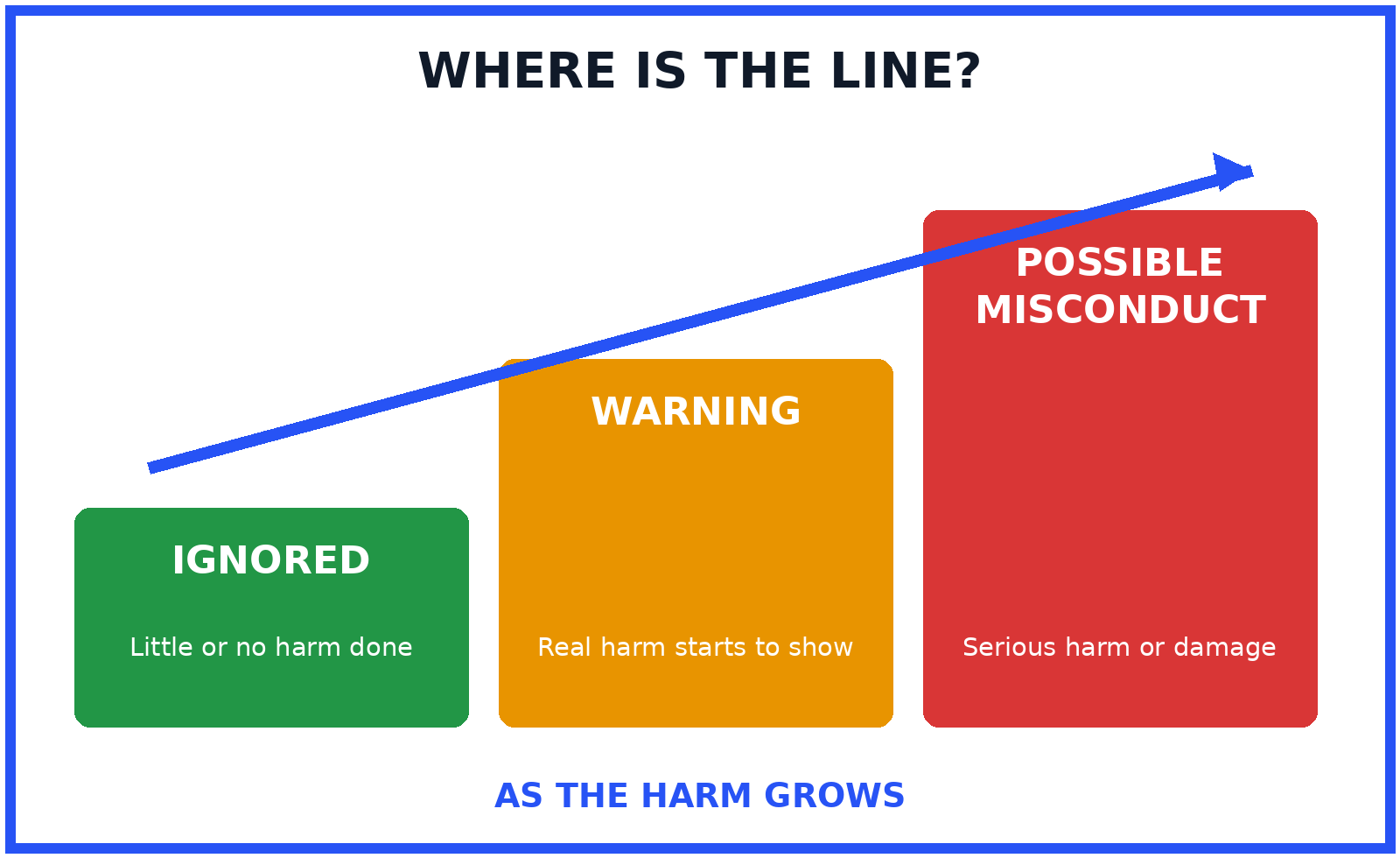
This general scale shows where the line usually sits:
| Behaviour | Likely consequence (general guidance only) |
|---|---|
| One-off act, small delay, no real harm | Usually ignored, or handled with an informal word about using judgment |
| A pattern, after the impact has been explained | A formal warning or a performance process becomes likely |
| Customers, coworkers, or deadlines knowingly harmed | Commonly treated as misconduct or serious poor performance |
| Safety rules weaponised, or damage done deliberately | Serious misconduct risk, dismissal is possible |
If you are an employee, the safest reading is simple. Following a bad rule once to make a quiet point is a gamble. Doing it repeatedly, or letting real harm happen when you could have warned someone, is the point where employers stop seeing a joke and start seeing conduct.
What managers can do to prevent it
Punishing the behaviour without fixing the cause just teaches the team to hide it better. BambooHR recommends keeping a continuous feedback loop and reviewing the employee handbook on a regular basis, so policies stay relevant instead of becoming weapons. Gusto gives similar advice: explain the reason behind a rule, invite feedback before it launches, and listen when objections come in.
Use this six-point prevention checklist:
- Explain the why. Every new rule ships with the reason for it. People follow the spirit of rules they understand.
- Review rules on a schedule. Once a quarter, ask which rules staff are working around or obeying in ways that hurt. Retire or rewrite the worst ones.
- Build a flag-it-first channel. Give staff a simple rule: if an instruction looks wrong, flag it before you follow it, and you will never be punished for flagging. This one channel removes most of the reason to comply maliciously.
- Answer flags fast, and in writing. A concern that gets a same-day written answer rarely turns into a protest. A concern that vanishes does.
- Judge outcomes, not box-ticking. If reviews and bonuses reward hitting the literal target, staff will hit the literal target. Reward the result the rule was meant to produce.
- Treat each case as data. One incident is a conversation. Three incidents around the same rule is the rule telling you it is broken.
For employees, there is a lower-risk way to make the same point. Put the concern in writing before you act: “Following this exactly means the report goes out without the sales figures. Do you want me to go ahead anyway?” You have flagged the flaw, created a record, and kept yourself out of the conduct zone. If the answer is yes, the outcome is now the decision-maker’s problem, openly.
This guide sits in our Business section, alongside plain-English explainers on how workplaces run. You can browse the latest guides and tools from the TechyHunt homepage.
Frequently asked questions
What does maliciously compliant mean?
It describes a person who follows instructions or rules exactly as written while knowing the result will be unhelpful. A maliciously compliant employee does not refuse an order. They carry it out so literally that the flaw in the order causes the damage.
Is malicious compliance illegal?
In most cases, no. The employee followed the instructions they were given, which is why it is hard to treat as a legal problem by itself. It can still breach a conduct policy if it knowingly causes harm, and some group action about working conditions has legal protection in some places. The details depend on your contract and your local law.
Is malicious compliance the same as work to rule?
They are close cousins. Work to rule means doing only what your contract or rulebook requires and nothing extra, usually as an organised group action. Malicious compliance is usually an individual act: following one instruction so literally that its flaw shows. The intent to expose a problem is shared by both.
Can you be fired for malicious compliance?
Yes, it is possible, especially if the behaviour is repeated or knowingly causes real harm, such as lost customers or missed deadlines. A single low-harm incident is more likely to draw an informal warning. Your contract, your employer’s policies, and your local employment law all affect the outcome, so treat any general guide, including this one, as background rather than advice on your own case.
How can managers spot malicious compliance?
Look for sudden, perfect obedience from a previously flexible employee, work stopping at exact cut-off points, rules quoted back word for word, and problems that the employee clearly saw coming but never mentioned. The strongest sign is a change: judgment and goodwill disappear at the same time, usually right after a dispute, a new rule, or a concern that was ignored.
Sources

Jimmy
Jimmy is the editor behind TechyHunt. He covers business software, cybersecurity and practical tech how-tos, and leads testing for the site's free converter tools. His focus is clear, jargon-free guides that help readers make smarter tech decisions, faster.
Every article follows our Editorial Standards. Spotted an error? Tell us.