On this page
- What is an IoT platform?
- How an IoT platform works, step by step
- The five layers of an IoT platform
- The four types of IoT platform
- Notable IoT platforms and companies
- Should you build your own platform instead?
- How to choose: match the type to the job
- The pre-buy checklist: 10 questions to ask any vendor
- Frequently asked questions
- What is the difference between an IoT platform and IoT software?
- Is AWS IoT Core an IoT platform?
- What happened to Google Cloud IoT Core?
- How much does an IoT platform cost?
- Can a small business use an IoT platform, or is it only for large companies?
Quick answer: An IoT platform is the software layer that sits between connected devices and the apps people use. It connects devices, gives each one a secure identity, collects and cleans their data, and feeds that data into dashboards, alerts, and business systems. Businesses buy one instead of building all of that plumbing themselves.
Think of a delivery company with trackers in 500 vans. The trackers are simple. The hard part is everything behind them: knowing which tracker is which, keeping the connection secure, storing millions of location pings, and turning them into a live map. That behind-the-scenes work is the platform.
What is an IoT platform?
IoT stands for Internet of Things, meaning everyday objects fitted with sensors and a network connection. An IoT platform is the set of services that manages those objects once they are online.
A useful way to picture it is as a translator and a traffic controller in one. Devices speak in short technical messages, often using a lightweight protocol called MQTT. People and business software need charts, alerts, and records instead. The platform takes in the raw messages, checks they came from a real device, stores them safely, and hands them on in a form apps can use. It also sends commands back down, such as a firmware update or a change to how often a sensor reports.
Without a platform, every project team has to build this plumbing from scratch, and then keep it secure and running at 3 a.m. when something breaks. That is why most businesses rent a platform, or install an open source one, and spend their own effort on the product or process that makes them money.
How an IoT platform works, step by step
- A device connects and proves who it is. When a sensor or tracker comes online, it presents its own credentials. The platform checks them before accepting a single reading, so a random device cannot feed fake data into your system.
- The device sends readings. Temperature, location, vibration, battery level: small messages flow in, often every few seconds or minutes, from every device in the fleet.
- The platform sorts and stores them. Rules decide what happens to each message: store it, compare it against a limit, or pass it straight to another system.
- People and software act on the data. A dashboard shows the current state, an alert fires when a limit breaks, and business software, such as a maintenance or billing system, receives the record it needs.
- Commands travel back down. The platform sends instructions to the device: report more often, restart, or install the update waiting for it.
Every step sounds simple on its own. The platform earns its place by doing all five, for thousands of devices at once, without dropping messages when the network stumbles.
The five layers of an IoT platform
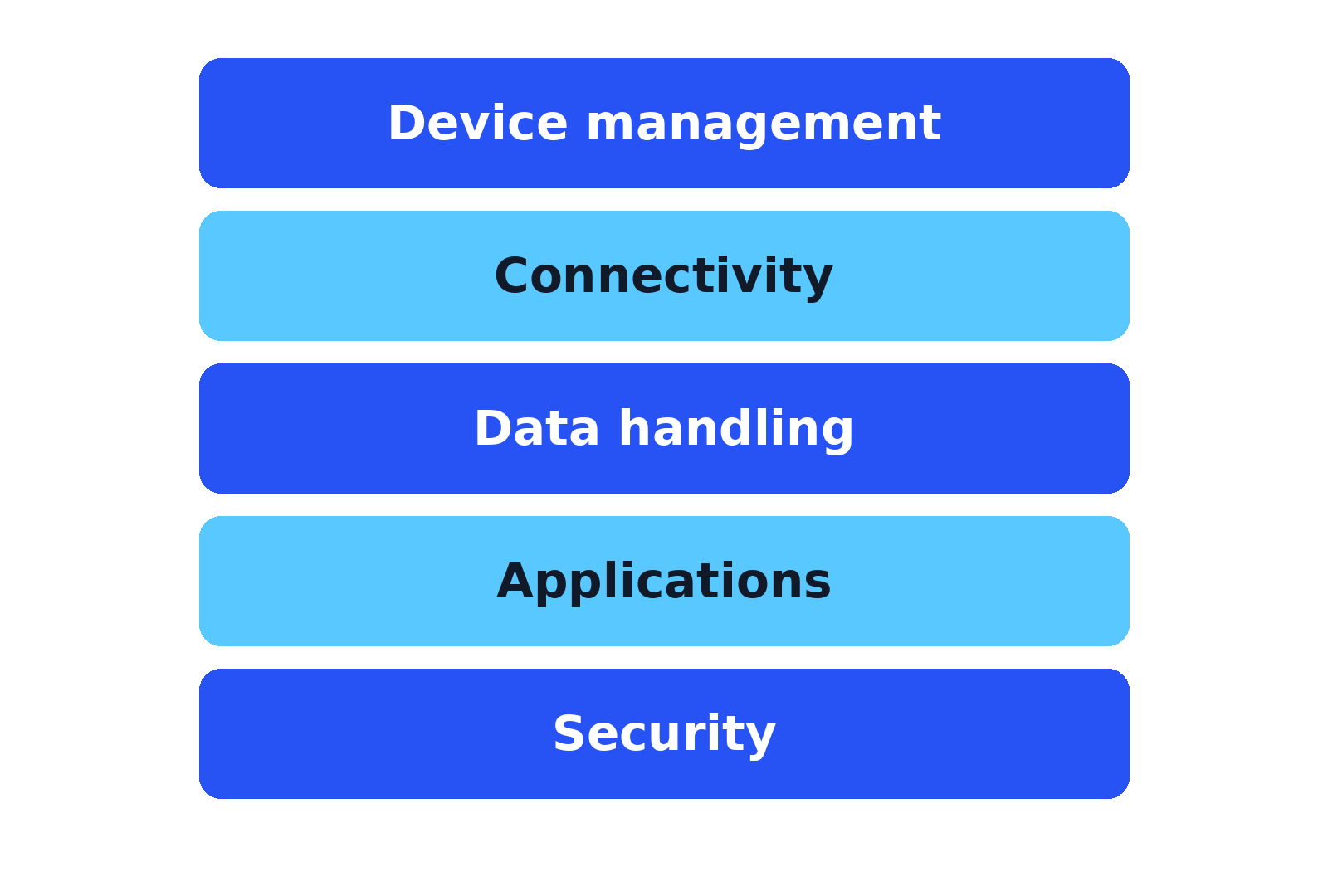
Vendors slice their products up in different ways, but almost every platform covers the same five layers. If a layer is missing, you end up building it yourself, so this list doubles as a gap check when you read a sales page.
| Layer | What it does | What goes wrong without it | Examples confirmed current |
|---|---|---|---|
| Device management | Registers each device, gives it an identity, tracks its health, and pushes software updates over the air | A fleet of devices you cannot patch, so one bug or security hole means visiting every device by hand | AWS IoT Core, Azure IoT Hub, ThingsBoard, Particle |
| Connectivity | Moves messages between devices and the cloud over Wi-Fi, cellular, LoRaWAN, or wired networks, and manages SIMs and data plans | Devices that go silent when a network changes, and no single place to see which units are offline | Soracom for cellular, AWS IoT Core, ThingsBoard gateways |
| Data handling | Collects readings, cleans and converts them, stores them, and routes them to the right system | A flood of raw readings nobody can search, bill from, or act on | AWS IoT Core rules engine, Azure IoT Hub message routing, ThingsBoard rule chains |
| Applications | Dashboards, alerts, reports, and the APIs that connect device data to business software | Data that exists but never reaches the people who could act on it | Losant, ThingsBoard dashboards, ThingWorx, Siemens Insights Hub |
| Security | Per-device passwords or certificates, encrypted traffic, and control over who can see or command each device | One stolen password that opens the whole fleet, and no way to cut off a single bad device | Azure IoT Hub per-device authentication, AWS IoT Core mutual authentication, ThingsBoard access control |
Two layers deserve a plain warning. Security is not a feature you add later: a platform that identifies devices as a group, instead of one by one, cannot revoke a single lost device. And device management decides your workload for years, because the update system is what lets you fix a device in the field without a site visit.
One term you will meet while comparing platforms is edge computing. It means handling some data on a small computer near the devices, inside the building or factory, instead of sending everything to the cloud first. The edge box can filter readings, keep machines running during an internet outage, and send only the summary onwards. Most serious platforms now offer some edge option: Azure IoT Hub extends to IoT Edge modules, ThingsBoard sells an Edge add-on, and Losant offers an edge agent. If your site has a weak connection, or a machine that must react in a split second, ask about the edge option early, because retrofitting it later is painful.
The four types of IoT platform
End-to-end platforms cover all five layers and aim to take you from first device to finished app. ThingsBoard, Losant, and Particle sit here. They suit teams that want one vendor and a fast start. The trade-off is that you build inside their tools, so leaving later takes work.
Connectivity platforms focus on getting devices online and keeping them there, especially over cellular networks. Soracom is the clearest example: SIMs, carrier switching, and a console for the fleet, with data passed on to your cloud. You still need your own data and application layers.
Cloud platforms come from the big cloud providers. AWS IoT Core and Azure IoT Hub handle connection, identity, and message routing at very large scale, and expect you to plug in the same provider’s storage, analytics, and app tools around them. Strong on scale and security, weaker as a ready-made app.
Analytics and industrial platforms start from the data and the factory floor rather than the device. Siemens Insights Hub (the platform previously called MindSphere) and ThingWorx from PTC are built for plants and machine builders, with asset models, production dashboards, and links into engineering and maintenance systems.
There is also a hosting choice hiding inside the type choice. Cloud platforms run on the vendor’s servers, so you start fast and never maintain the platform itself. On-premises platforms run on your own servers: ThingsBoard, for example, offers both a hosted cloud edition and an on-premises edition you install yourself, which matters if your data cannot leave the building for legal or policy reasons. Hybrid setups keep sensitive processing on site and send the rest to the cloud. Decide this early, because moving a live fleet between hosting models is a project in its own right.
Notable IoT platforms and companies
Because the supporting search for this topic is “internet of things companies”, here is the landscape in plain groups. Every name below was checked on the company’s own pages on 21 October 2026.
- Cloud providers: AWS IoT Core (Amazon) and Azure IoT Hub (Microsoft) are the two big general-purpose options, both current and actively sold.
- End-to-end specialists: ThingsBoard (open source, with cloud and on-premises editions), Particle (a platform service aimed at companies shipping connected products), and Losant (an enterprise platform with a low-code workflow engine; Losant is currently joining SUSE, per the banner on its own site).
- Industrial names: ThingWorx (PTC, now presented under the Velotic name, latest release 10.2) and Siemens Insights Hub, which is what Siemens renamed MindSphere to.
- Connectivity: Soracom, a cellular connectivity platform used by fleets that cross borders and carriers.
Step back, and the wider family of internet of things companies falls into four groups. Device and chip makers build the sensors, trackers, and radios. Platform companies run the software layer this article is about. Connectivity providers, from big mobile carriers to specialists like Soracom, sell the networks and SIMs. System integrators are the firms other businesses hire to design and assemble the whole thing. When you read a list of IoT companies, placing each name in one of these four groups tells you what they actually sell, and stops you comparing a SIM provider with a software platform as if they were rivals.
Two famous names you should not build on. Google Cloud IoT Core was retired on August 16, 2023, as Google Cloud’s own documentation confirms. IBM shut its Watson IoT Platform on December 1, 2023, with no direct replacement. Old articles and videos still recommend both. If a guide tells you to start a project on either one, the guide is out of date, and that is exactly why the exit questions in the checklist below matter.
Should you build your own platform instead?
Some teams ask why they cannot just build this themselves. For a handful of devices and one simple job, they can: a small script that receives messages and writes them to a database works fine for a pilot. The problem is what happens at device number 500. You now need per-device security, an update system that cannot brick the fleet, storage that survives years of readings, and someone on call when it breaks at night. Each of those is a product on its own. The honest rule: build your own only when the platform itself is the product you plan to sell, or when a rule forces everything to stay in-house and no vendor can meet it. Everyone else is buying time and safety, not software features.
How to choose: match the type to the job
Start with the job, not the brand. The right platform type follows from where the devices live and what happens to the data, and the wrong type stays wrong no matter how polished the demo looks. Use the table to narrow the field to one or two types, then run the checklist below against the specific vendors in that type.
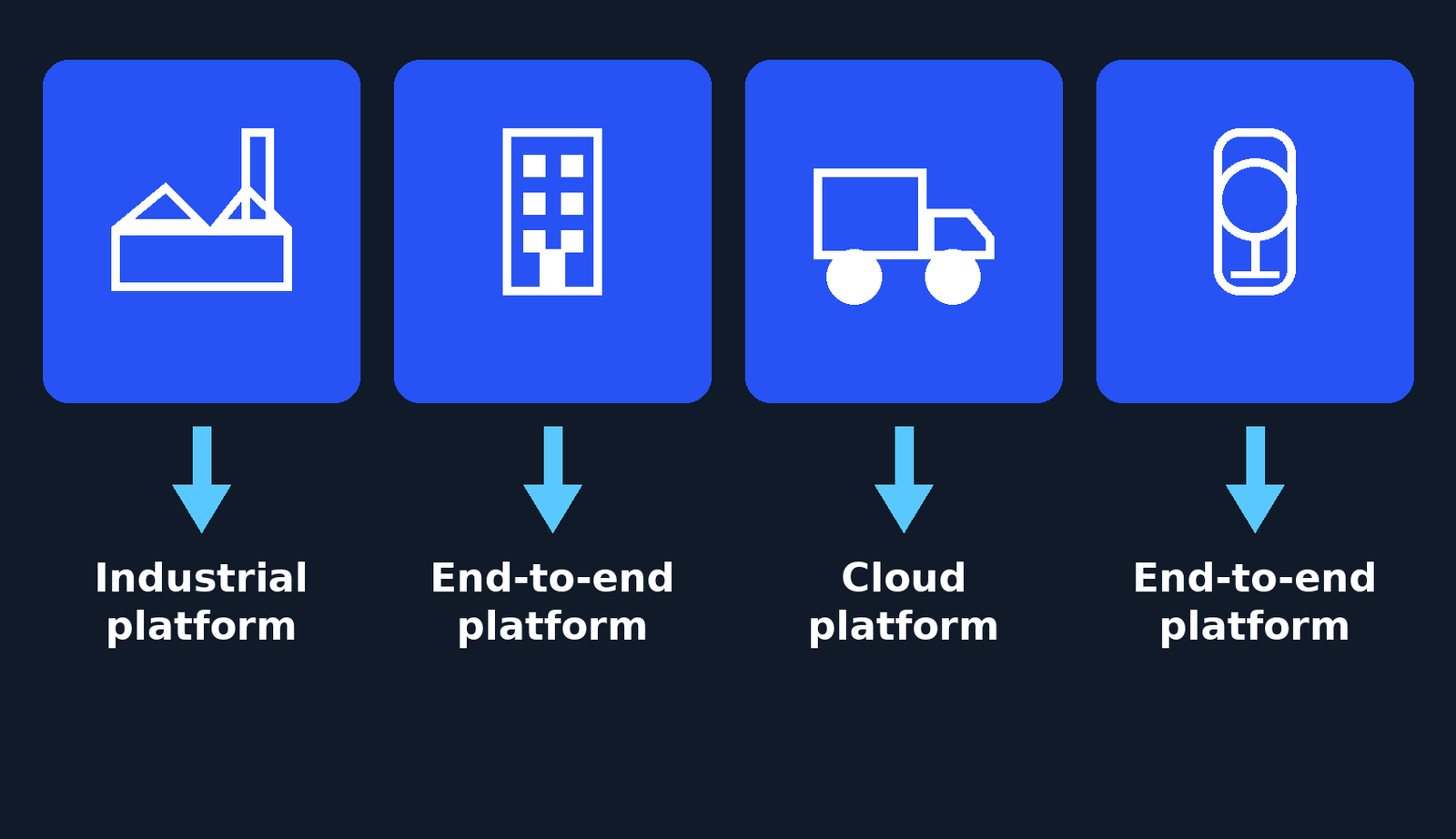
| Your use case | Platform type that usually fits | Why |
|---|---|---|
| Factory or industrial equipment | Industrial or end-to-end platform (ThingWorx, Siemens Insights Hub, ThingsBoard) | Machine protocols, asset models, and plant dashboards come built in |
| Smart building (energy, access, air quality) | End-to-end platform (ThingsBoard, Losant) | Many sensor types, simple dashboards, alerts matter more than raw scale |
| Logistics and fleet tracking | Connectivity platform plus cloud services (Soracom with AWS or Azure), or an end-to-end platform | Coverage and roaming decide success before features do |
| A company building a connected product to sell | End-to-end platform (Particle, ThingsBoard, Losant) | Device identity, over-the-air updates, and customer accounts are the product’s backbone |
The pre-buy checklist: 10 questions to ask any vendor
Copy this list into your evaluation. A vendor who answers all ten clearly is a safer bet than one with the longest feature page.
- Which protocols do you support today (MQTT, HTTPS, CoAP, LoRaWAN), and which ones are on a roadmap rather than live?
- How is each device identified, and can I revoke one device without touching the rest of the fleet?
- How do over-the-air updates work, and can I roll an update back if it fails?
- What exactly am I charged for: devices, messages, data stored, or users? Ask for the price shape at 100, 10,000, and 100,000 devices.
- Who owns the device data, and can I export all of it, in an open format, at any time?
- What does leaving look like? Ask for the migration path and the timeline in business days, not in “a few weeks”.
- Where is data stored, and which regions can I choose between?
- What uptime do you commit to in writing, and what happens when the platform is down: do devices queue messages or lose them?
- Can the platform run partly on site (at the edge) if a building or factory loses its internet link?
- Has any part of your platform been renamed, merged, or retired in the last three years, and how were existing customers handled? The Google and IBM closures show why this question is not rude.
While you test, expect small clean-up jobs, like readings that arrive in mixed units or formats. Our free converter tools handle the quick conversions while you compare what the platform gives you.
Whatever you choose, run a small pilot before you commit the whole fleet. Put ten or twenty real devices on the platform, in the real building or on the real route, and leave them for a few weeks. During the pilot, test the boring things on purpose: push an update and roll it back, export your data and check the file opens cleanly, and revoke one device to confirm the rest keep working. A platform that handles the pilot honestly will usually handle the rollout. A platform that struggles with twenty devices will not improve with two thousand.
Frequently asked questions
What is the difference between an IoT platform and IoT software?
IoT software usually means one application, such as a dashboard or a tracking app. An IoT platform is the layer underneath it: connection, device identity, data handling, and security that many applications can share. One platform normally supports several pieces of IoT software.
Is AWS IoT Core an IoT platform?
Yes. AWS IoT Core is Amazon’s cloud IoT platform service. It connects devices over MQTT, HTTPS, and LoRaWAN, gives each device an identity, and routes data into other AWS services. On its own it is closer to the connection and data layers, so most projects add AWS or third-party tools for dashboards and apps.
What happened to Google Cloud IoT Core?
Google retired it. The service was deprecated and shut down on August 16, 2023, and Google pointed customers towards partner platforms instead. Any tutorial that still tells you to build on it is out of date.
How much does an IoT platform cost?
There is no single price shape. Cloud services tend to charge around messages and connected devices, end-to-end platforms charge per device or per tier, and open source options such as ThingsBoard shift the cost to hosting and your own time. Because vendors change pricing pages often, compare live quotes for your device count rather than trusting figures in articles, including ours.
Can a small business use an IoT platform, or is it only for large companies?
Small businesses use them too. A common pattern is a small fleet, such as cold storage sensors, rental equipment trackers, or building energy monitors, run on an end-to-end platform so there is no server to maintain. The layers and the checklist in this guide scale down as well as up.
Sources
- AWS IoT Core official product page (connectivity, mutual authentication, rules engine)
- Azure IoT Hub official product page (per-device authentication, provisioning, Device Update)
- ThingsBoard official site (open source IoT platform, cloud and on-premises)
- Particle official site (IoT platform-as-a-service, console, OTA software releases)
- Losant official site (enterprise IoT platform, joining SUSE banner)
- Siemens Insights Hub capabilities page ("MindSphere has evolved into Insights Hub")
- ThingWorx official product page (PTC, industrial platform)
- Soracom official site (global cellular IoT connectivity)
- Google Cloud documentation, Cloud IoT API library page (IoT Core deprecated, retirement date August 16, 2023)
- The Register (IBM Watson IoT Platform sunset on December 1, 2023, per IBM customer notice)

Jimmy
Jimmy is the editor behind TechyHunt. He covers business software, cybersecurity and practical tech how-tos, and leads testing for the site's free converter tools. His focus is clear, jargon-free guides that help readers make smarter tech decisions, faster.
Every article follows our Editorial Standards. Spotted an error? Tell us.