
On this page
- What LLC and Inc actually mean
- LLC vs Inc at a glance
- Taxes: where the two really split
- A worked tax example
- How you pay yourself
- Ownership and raising money
- How forming each one works
- Paperwork and day-to-day rules
- Which one fits your situation?
- Can you switch later?
- A quick note before you decide
- Frequently asked questions
- Is an LLC the same as a corporation?
- Which is cheaper to start, an LLC or a corporation?
- Can an LLC be taxed like a corporation?
- Do LLC owners pay tax twice?
- Should a startup that wants investors form an LLC or a corporation?
Quick answer: An LLC is a flexible business structure owned by members, and by default its profits are taxed once, on the owners’ personal tax returns. Inc is short for incorporated, which means a corporation. A corporation is owned by shareholders, pays its own federal tax at a flat 21 percent, and can be taxed a second time when profits are paid out as dividends. Pick an LLC for simplicity. Pick a corporation if you plan to raise money from investors.
This guide compares the two side by side, then maps them to five real founder situations. It covers US structures only, and it is general information, not legal or tax advice.
What LLC and Inc actually mean
LLC stands for limited liability company. It is a business structure created under state law, and its owners are called members. The IRS notes that most states do not restrict who can be a member, and there is no maximum number of members. An LLC is organized under state law. It is not a corporation, even though it offers similar protection.
Inc is short for incorporated. It means the business is a corporation, a legal entity that exists separately from its owners. The owners are called shareholders, and they own pieces of the company called stock. The U.S. Small Business Administration describes a corporation as an entity that can make a profit, be taxed, and be held legally liable on its own.
Both structures do one big job in common: they separate the business from the owner. In most cases, your house, car, and savings stay protected if the business runs into debt or a lawsuit. The real differences sit in taxes, paperwork, ownership rules, and how money can be raised.
The protection has limits, and both structures share them. The SBA puts it carefully: an LLC protects you from personal liability in most instances, not all. If you sign a personal guarantee on a loan, that debt is yours either way. If you cause harm through your own actions, a business structure does not shield you from that. And if you mix business money with personal money in one account, a court may treat the two as the same. Separate bank accounts and clean records are what keep the wall standing.
LLC vs Inc at a glance
| Point | LLC | Corporation (Inc) |
|---|---|---|
| Owners are called | Members | Shareholders |
| Ownership unit | Membership interest | Shares of stock |
| Who can own it | Almost anyone, including other companies and foreign entities (IRS) | Anyone for a C corp; an S corp limits owners (see taxes) |
| Number of owners | No maximum, one member is allowed (IRS) | No maximum for a C corp; an S corp is capped at 100 shareholders |
| Who runs it | The members, or managers they appoint | A board of directors and officers |
| Formation filing | Articles of organization filed with the state | Articles of incorporation filed with the state |
| Formation cost | A state filing fee; the amount is set by the state and varies | A state filing fee; set by the state, and the extra setup steps usually cost more |
| Ongoing paperwork | Light: an operating agreement and any state reports | Heavy: bylaws, board meetings, minutes, annual reports |
| Federal tax by default | Pass-through: profit lands on the owners’ personal returns | The corporation pays its own tax at a flat 21 percent |
| Second tax layer | No | Yes, when profits are paid out as dividends |
| Tax flexibility | Can elect to be taxed as a corporation (Form 8832), or as an S corp if it qualifies | Starts as a C corp; can elect S corp status if it qualifies (Form 2553) |
| Raising investment | Hard: there is no stock to sell | Built for it: investors buy stock |
| Selling your share | Can be slow; the agreement often controls transfers | Shares are usually easy to sell or transfer |
| Best for | Small teams, freelancers, property holders, simple ownership | Startups raising money, companies planning to sell stock or go public |
Taxes: where the two really split
Tax is the difference most founders feel first. By default, an LLC does not pay federal income tax as a company. The profit passes through to the owners, who report it on their personal tax returns. The IRS treats a one-member LLC as a disregarded entity, part of the owner’s own return, and a multi-member LLC as a partnership, unless the LLC files Form 8832 and elects to be treated as a corporation. One catch, flagged by the SBA: LLC members are considered self-employed and must pay self-employment tax contributions toward Medicare and Social Security.
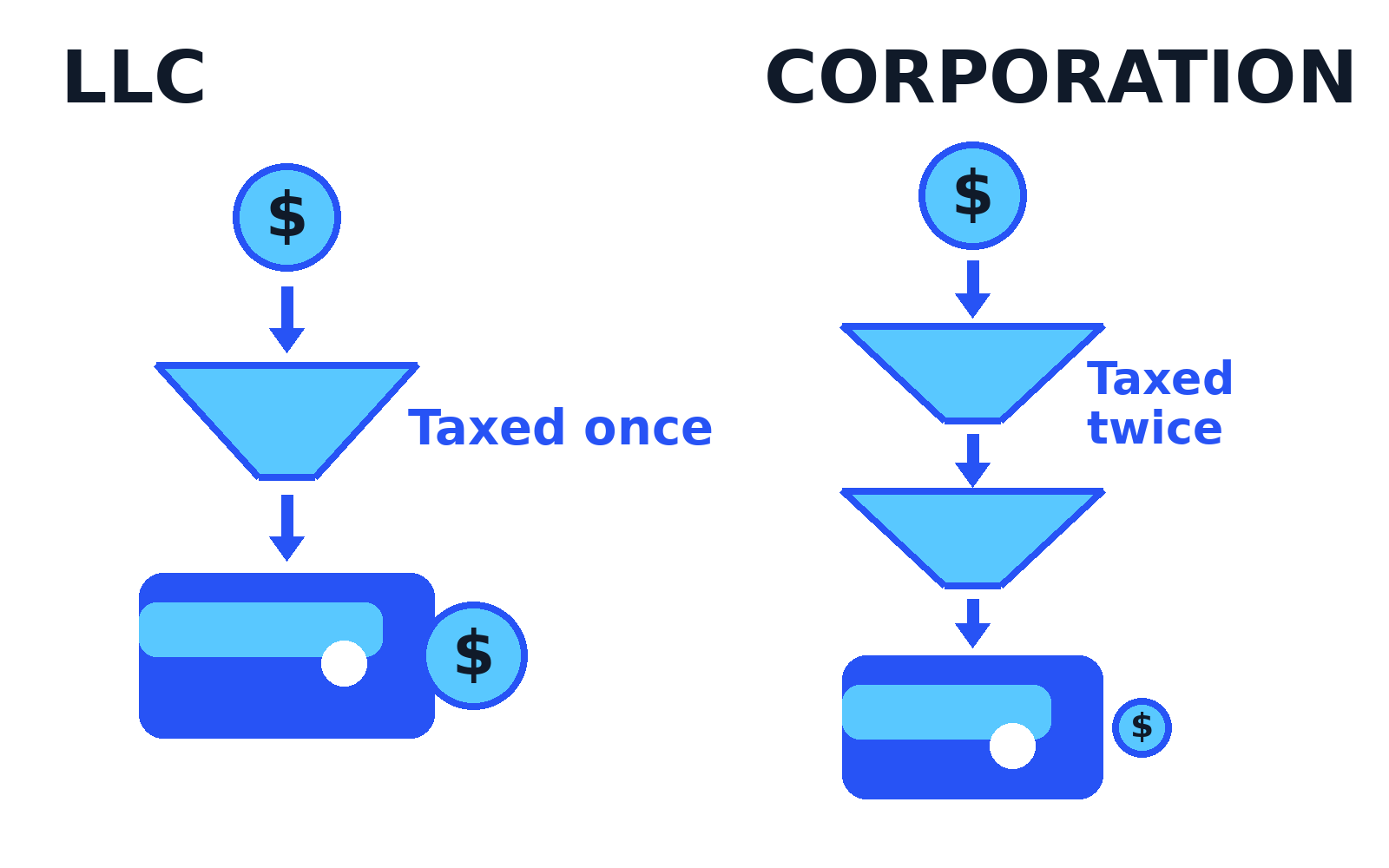
A corporation works the other way. It is its own taxpayer. It pays federal tax on its profit at a flat 21 percent, the rate the IRS confirms replaced the old graduated corporate rates. Then, if the after-tax profit is paid out to shareholders as dividends, the shareholders pay personal tax on those dividends too. The SBA calls this out plainly: corporate profits are sometimes taxed twice, once when the company earns them and again when dividends are paid. State taxes can apply on top for both structures, and they vary by state.
There is an escape hatch, and it matters. A corporation can elect S corporation status with the IRS (Form 2553), which lets profits pass through to the owners’ personal returns with no corporate-level tax, as the IRS S corporations page explains. The trade-off is a strict set of limits: no more than 100 shareholders, only one class of stock, and shareholders may only be individuals, certain trusts, and estates. No companies, no partnerships, and no non-resident alien shareholders. An LLC can also elect S corp tax treatment if it meets those same rules.
A worked tax example
Numbers make the tax gap easier to see. Say a business makes $100,000 of profit in a year. This is a simplified example. It leaves out state taxes, deductions, and salaries, and it uses only the federal corporate rate confirmed by the IRS.
| LLC (default) | Corporation (C corp) | |
|---|---|---|
| Profit | $100,000 | $100,000 |
| Tax at company level | $0, there is no separate company tax | $21,000 (21 percent federal corporate rate, per the IRS) |
| What the owners are taxed on | The full $100,000, on their personal returns, at their own personal rates | Dividends only, if and when the profit is paid out |
| Left inside the business | Nothing is held back by a company tax layer | $79,000 stays in the company |
| Second layer | None | Personal tax on dividends, at each shareholder’s own rate |
Read it this way. The LLC owner is taxed once, on the whole profit, whether the cash leaves the business or not. The corporation pays $21,000 up front and keeps $79,000. That looks cheaper until the owner wants the money at home: paying it out as dividends triggers the second layer. Many owner-run corporations pay the owner a salary instead, because salary is a business cost that reduces the company’s taxable profit. The owner then pays personal tax on the salary. Either way, money that reaches the owner gets taxed at the personal level in the end.
How you pay yourself
The structures also pay the owner in different ways. In an LLC, the owners simply take money out as draws or distributions, following the split set in the operating agreement. There is no payroll to run for the owners themselves, which keeps life simple. The trade-off is the tax point from the SBA above: members are taxed as self-employed on the profit, and the tax is owed on the full profit for the year, even on money left sitting in the business account.
In a corporation, an owner who works in the business is an employee of it. The corporation pays that owner a salary through payroll, and the salary counts as a business cost. Whatever profit is left can stay in the company, or go out as dividends to shareholders. That split, salary plus possible dividends, gives corporations more moving parts, and more planning room, but it also means payroll, withholding, and filings that an LLC owner never touches.
Ownership and raising money
Ownership is where the corporation pulls ahead. A corporation raises money by selling stock, and the SBA lists this as a clear advantage, one that also helps attract employees who want shares. Investors know stock. They know how to buy it, price it, and sell it later. Venture capital funds in particular are built around stock, preferred shares, and boards, none of which an LLC offers in the standard way. The S corp limits above also shut most funds out: a fund is not an individual, and one class of stock cannot give investors the special terms they usually ask for.
An LLC trades that fundraising power for freedom. Members can split profits in almost any way they agree to in the operating agreement, even splits that do not match ownership percentages. A silent partner can take a set share while the working partner takes more. If you plan to fund growth from your own profits or a bank loan, that freedom is usually worth more than stock you never plan to sell.
How forming each one works
The steps are cousins, not twins. To form an LLC, you choose a state, choose a name, file articles of organization with the state, write an operating agreement that sets out who owns what and who decides what, and get an EIN from the IRS for taxes and banking. To form a corporation, you choose a state, choose a name, file articles of incorporation, write bylaws, appoint directors and officers, hold a first board meeting, and issue stock to the owners.
Both filings carry a state fee, and the fee is set by the state, so the same step costs different amounts in different states. Some states add yearly report fees or franchise taxes on top, again at their own rates. State offices often quote processing times in business days, which is why a form sent on a Friday can sit still until Monday. The corporation route usually costs more overall, because there are more documents and more formal steps to keep up.
Paperwork and day-to-day rules
A corporation comes with a fixed structure: shareholders elect a board, the board appoints officers, and officers run the daily work. The SBA notes that corporations require more extensive record-keeping, operational processes, and reporting than other structures. In practice that means annual shareholder meetings, board minutes, and careful records. Skip the formalities for too long and you risk the liability protection the structure was bought for.
An LLC has no required board and no required meetings under the usual state rules. The operating agreement is the rulebook, and the owners write it themselves. Most states still ask for a periodic report to keep the LLC active, but the day-to-day load is far lighter. For a small team, that difference alone is often the deciding factor.
Which one fits your situation?

| Your situation | Usual pick | Why |
|---|---|---|
| Solo freelancer or consultant | LLC | One layer of tax, simple paperwork, and liability cover for your personal assets. A one-member LLC is taxed as part of your own return by default. |
| Two partners running a local service business | LLC | You can split profits and duties freely in the operating agreement, with no board or meeting rules to maintain. |
| Startup planning to raise venture money | Corporation (C corp) | Investors buy stock, and funds cannot use an S corp because of its owner limits and single class of stock. |
| Online store owner selling products | LLC | Liability cover and pass-through tax keep things simple while you grow. You can elect S corp tax treatment later if it starts to fit better. |
| Real estate holder buying rental property | LLC | Property owners commonly hold rentals in LLCs for liability cover, flexible ownership, and pass-through tax. |
These are starting points, not rulings. A business with unusual risk, partners in several states, or a sale planned soon can land on the other answer.
Can you switch later?
Usually, yes. Many states allow a direct conversion from an LLC to a corporation. Where that is not offered, the common path is to form a new corporation and move the business into it. Switching is real paperwork, and it can have tax effects, so it is a job to plan with a professional rather than a form to rush. The good news: choosing an LLC today does not lock the door if the business later needs investors.
A quick note before you decide
This article is general information about US business structures, not legal or tax advice. State rules differ on fees, reports, and how each structure is taxed, and your own facts can change the right answer. Before you file, have a lawyer or a tax professional look at your situation once. That one review is cheaper than restructuring later.
Still setting up the basics? If you work with partners or clients in other countries, you will convert currencies, dates, and units as you go. Our free converter tools run in your browser with no sign-up.
Frequently asked questions
Is an LLC the same as a corporation?
No. An LLC is its own structure, organized under state law and owned by members. A corporation is a separate structure, created by incorporating, and owned by shareholders who hold stock. The two share liability protection, but their tax treatment, paperwork, and ownership rules differ.
Which is cheaper to start, an LLC or a corporation?
Filing fees are set by each state, so there is no single national price for either one. The state fee for an LLC is often similar to or lower than the corporation fee in the same state, but the bigger gap is ongoing: a corporation needs bylaws, meetings, minutes, and stock records, which adds cost and time every year.
Can an LLC be taxed like a corporation?
Yes. The IRS lets an LLC elect corporate tax treatment by filing Form 8832. An LLC that meets the IRS rules can also elect S corporation treatment with Form 2553, which taxes the owners instead of the company. The default, with no election, is pass-through tax on the owners’ personal returns.
Do LLC owners pay tax twice?
No, not by default. LLC profit is taxed once, on the owners’ personal returns. The catch is different: the SBA notes that LLC members are considered self-employed and must pay self-employment tax contributions toward Medicare and Social Security on their earnings.
Should a startup that wants investors form an LLC or a corporation?
A corporation, in almost every case. Investors buy stock, and venture funds are set up for corporate shares and boards. An S corp is also closed to most funds, because the IRS limits it to 100 shareholders, one class of stock, and individual shareholders only. Most investor-ready startups run as C corporations.
Sources

Jimmy
Jimmy is the editor behind TechyHunt. He covers business software, cybersecurity and practical tech how-tos, and leads testing for the site's free converter tools. His focus is clear, jargon-free guides that help readers make smarter tech decisions, faster.
Every article follows our Editorial Standards. Spotted an error? Tell us.