
On this page
- How many hours are in a month?
- Hours in a month calculator
- Hours in a Month Calculator
- Hours in every month of 2026
- Hours in every month of 2027
- How many work hours are in a month?
- The 2,080-hour year: a useful standard with rough edges
- Salary to hourly: the quick conversion table
- Frequently asked questions
- How many hours are in a month?
- How many work hours are in a month?
- How many hours are in February?
- How many hours are in a 30-day month?
- How do I convert an annual salary to an hourly rate?
- Is a month exactly 4 weeks?
Quick answer: A month has between 672 and 744 hours. A 31-day month has 744 hours, a 30-day month has 720 hours, and February has 672 hours, or 696 in a leap year. If you mean work hours, a full-time month has 160 to 184 work hours at 40 hours a week, Monday to Friday.
People ask this question for payroll, freelance billing, project plans, and salary offers. The tricky part is that there is no single answer. Months are not the same length, and work hours depend on how the weekdays fall. This guide gives the exact count for every month of 2026 and 2027, a calculator for any month and any schedule, and the flat average that payroll systems use instead.
How many hours are in a month?
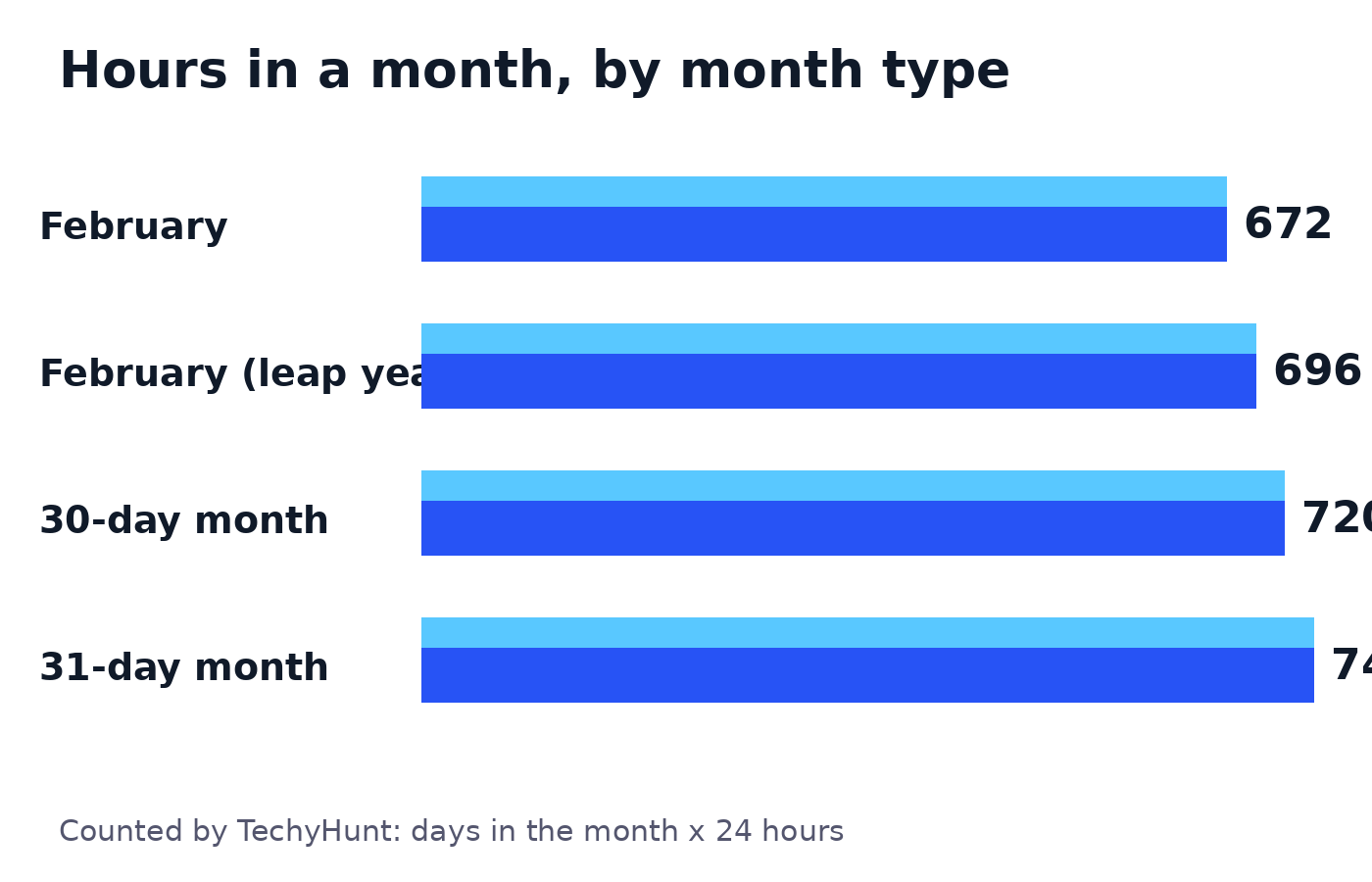
Every day holds 24 hours, so the math is simple: the days in the month times 24. Months come in three sizes, plus one special case.
| Month type | Days | Total hours |
|---|---|---|
| 31-day month | 31 | 744 |
| 30-day month | 30 | 720 |
| February, normal year | 28 | 672 |
| February, leap year | 29 | 696 |
Seven months have 31 days: January, March, May, July, August, October, and December. Four have 30 days: April, June, September, and November. February is the odd one out, with 28 days in a normal year and 29 in a leap year.
So what is the average? A normal year has 365 days and 8,760 hours. Split 12 ways, the average month holds exactly 730 hours. Tools that convert longer spans use a slightly higher figure, 730.485 hours per month, built from the average calendar year of 365.2425 days, which smooths out leap years (InchCalculator). For planning inside one normal year, 730 is the clean number. For one exact month, use its real count from the tables below.
Hours in a month calculator
Do not want to look up tables? Use the calculator. Pick a month and a year, enter the hours you work each week, and choose the days you work. It shows the days in the month, the total hours, the weekdays, and your work hours for that month.
Hours in a Month Calculator
Pick a month and a year, enter your weekly hours, and choose the days you work. The calculator shows the days in the month, the total hours, the weekdays, and your work hours.
Work hours count the days in your pattern only. Public holidays and leave are not subtracted, so your real total will be lower in months with holidays.
Hours in every month of 2026
Most pages give you one generic table for any year. We counted the real calendar instead. The method: total hours are the days in the month times 24. Weekdays are the Monday to Friday days. Work hours are the weekdays times 8, which is a 40-hour week before public holidays and leave are taken off.
Hours in 2026
| Month | Days | Total hours | Weekdays | Work hours (40 hrs/week) |
|---|---|---|---|---|
| January | 31 | 744 | 22 | 176 |
| February | 28 | 672 | 20 | 160 |
| March | 31 | 744 | 22 | 176 |
| April | 30 | 720 | 22 | 176 |
| May | 31 | 744 | 21 | 168 |
| June | 30 | 720 | 22 | 176 |
| July | 31 | 744 | 23 | 184 |
| August | 31 | 744 | 21 | 168 |
| September | 30 | 720 | 22 | 176 |
| October | 31 | 744 | 22 | 176 |
| November | 30 | 720 | 21 | 168 |
| December | 31 | 744 | 23 | 184 |
| Total 2026 | 365 | 8,760 | 261 | 2,088 |
Two things stand out. July and December are the longest work months of 2026, at 184 work hours each, and February is the shortest at 160. That is a gap of 24 work hours, or three full workdays, between the longest and shortest months. And the year holds 261 weekdays, not 260. A 365-day year is 52 full weeks plus one extra day, and when that extra day lands on a weekday, the weekday count rises to 261.
Hours in every month of 2027
The year totals for 2027 match 2026 exactly: 365 days, 8,760 hours, and 261 weekdays. The months shuffle around, though, so last year’s timesheet numbers will not carry over.
Hours in 2027
| Month | Days | Total hours | Weekdays | Work hours (40 hrs/week) |
|---|---|---|---|---|
| January | 31 | 744 | 21 | 168 |
| February | 28 | 672 | 20 | 160 |
| March | 31 | 744 | 23 | 184 |
| April | 30 | 720 | 22 | 176 |
| May | 31 | 744 | 21 | 168 |
| June | 30 | 720 | 22 | 176 |
| July | 31 | 744 | 22 | 176 |
| August | 31 | 744 | 21 | 168 |
| September | 30 | 720 | 22 | 176 |
| October | 31 | 744 | 21 | 168 |
| November | 30 | 720 | 22 | 176 |
| December | 31 | 744 | 23 | 184 |
| Total 2027 | 365 | 8,760 | 261 | 2,088 |
March jumps from 176 work hours in 2026 to 184 in 2027, while January falls from 176 to 168. If you plan staff cover, billing targets, or delivery dates by the month, work from the table for the year you are actually in. Counts calculated by TechyHunt, October 2026.
How many work hours are in a month?
Work hours are not the same as total hours. They are the hours inside your work pattern. For a full-time schedule of 8 hours a day, Monday to Friday, the count follows the weekdays. A month can hold 20 to 23 weekdays, so a full-time month holds 160 to 184 work hours.
| Month type | Weekdays it can hold | Work hours at 40 hours a week |
|---|---|---|
| February (28 days) | Always 20 | 160 |
| February (29 days, leap year) | 20 to 21 | 160 to 168 |
| 30-day month | 20 to 22 | 160 to 176 |
| 31-day month | 21 to 23 | 168 to 184 |
February in a normal year is the one fixed case. At exactly 28 days, it is four neat weeks, so it always holds 20 weekdays and 160 work hours, no matter which day of the week it starts on.
The payroll average is different. Employers rarely pay by the real calendar count, because pay would rise and fall every month. Instead, payroll uses a flat average: 2,080 work hours a year split 12 ways gives 173.33 work hours a month (Climb The Ladder sets out the payroll method). The real calendar average is a little higher: 2,088 scheduled hours split 12 ways is 174 a month in both 2026 and 2027. The averages are close, but a timesheet, an overtime claim, or a pro-rata salary for one named month needs that month’s real count.
Holidays and leave cut the count further. The work hours above are weekdays only. A public holiday that falls on a weekday removes one workday, and 8 work hours, from that month. Our guide to business days shows the full effect: in the US, the 261 weekdays of 2026 fall to 250 business days once the 11 federal holidays are taken off. Vacation and sick days come off your own total on top of that.
Not everyone works 40 hours. Many UK contracts use 37.5 hours a week, which is 7.5 hours a day. That pattern scales every figure in the tables by 0.9375: July 2026, for example, holds 172.5 work hours instead of 184. On the standard yearly view, a 37.5-hour week builds a 1,950-hour year before holidays and leave (Everhour). The calculator above handles any weekly figure and any pattern, including part-time schedules.
The 2,080-hour year: a useful standard with rough edges
You will see 2,080 everywhere in payroll and HR. It is 40 hours a week times 52 weeks, and it is the baseline for salary offers, benefits planning, and headcount math. It is a standard, not a calendar count, and two rough edges are worth knowing.
First, a real year is a little longer than 52 weeks. As the tables above show, 2026 and 2027 each hold 261 weekdays, which is 2,088 scheduled hours, not 2,080. Second, 2,080 counts scheduled hours, not hours actually worked. Take off public holidays, vacation, and sick days, and the hours a person really works land closer to 1,900 to 1,950 in a typical year (Everhour).
Keep the legal line separate, too. For US health coverage rules, the Internal Revenue Service counts a full-time employee as someone who works at least 30 hours of service a week, or 130 hours of service a month. That is a benefits threshold for large employers, not the 40-hour payroll standard most people mean by full-time.
Salary to hourly: the quick conversion table
The standard way to turn a salary into an hourly rate is to divide by 2,080. The table below uses that standard full-time assumption (40 hours a week, 52 weeks a year, gross pay before tax), so you can compare offers and rates on the same basis.
| Annual salary | Hourly rate (salary / 2,080) | Monthly pay (salary / 12) |
|---|---|---|
| $30,000 | $14.42 | $2,500 |
| $40,000 | $19.23 | $3,333 |
| $50,000 | $24.04 | $4,167 |
| $60,000 | $28.85 | $5,000 |
| $75,000 | $36.06 | $6,250 |
| $100,000 | $48.08 | $8,333 |
A clean example. A salary of $52,000 divided by 2,080 gives exactly $25 an hour. The method runs both ways: an hourly rate times 2,080 gives the matching salary, so $30 an hour is a $62,400 salary on the same basis.
Freelancers can run the math the other way, from the month tables. If your rate is $25 an hour and a month holds 176 billable work hours, that month carries $4,400 of billable time before expenses and tax. A short month like February, at 160 hours, carries $4,000 at the same rate. That gap is why flat monthly retainers and per-hour billing rarely match across a full year.
Need a different conversion while you plan? Our free converter tools run in the browser with no sign-up.
Frequently asked questions
How many hours are in a month?
It depends on the month. A 31-day month has 744 hours, a 30-day month has 720 hours, and February has 672 hours, or 696 in a leap year. Spread over a full year, the average month has 730 hours.
How many work hours are in a month?
A full-time month has 160 to 184 work hours at 40 hours a week, Monday to Friday, depending on how many weekdays the month holds. Payroll systems use a flat average of 173.33 work hours a month, which is 2,080 hours a year split 12 ways.
How many hours are in February?
February has 672 hours in a normal year (28 days times 24). In a leap year, February has 29 days and 696 hours. The next leap year February is in 2028.
How many hours are in a 30-day month?
A 30-day month has 720 hours in total (30 days times 24). Its work hours at a full-time Monday to Friday pattern range from 160 to 176, because a 30-day month can hold 20, 21 or 22 weekdays.
How do I convert an annual salary to an hourly rate?
Divide the annual salary by 2,080, the standard full-time year of 40 hours a week for 52 weeks. A $52,000 salary divided by 2,080 gives $25 an hour. The same method in reverse turns an hourly rate into a salary: multiply by 2,080.
Is a month exactly 4 weeks?
No. Only February in a non-leap year is exactly 4 weeks, at 28 days. Every other month is 4 weeks plus 2 or 3 extra days, which is why the hours in a month change from month to month.
Sources
- InchCalculator: Months to Hours Converter
- Climb The Ladder: How Many Full-Time Work Hours Are in a Month?
- Everhour: How Many Working Hours in a Year
- Internal Revenue Service: Identifying Full-time Employees
- TechyHunt: Month-by-month hour and weekday counts for 2026 and 2027, counted from the calendar (method in this guide)

Jimmy
Jimmy is the editor behind TechyHunt. He covers business software, cybersecurity and practical tech how-tos, and leads testing for the site's free converter tools. His focus is clear, jargon-free guides that help readers make smarter tech decisions, faster.
Every article follows our Editorial Standards. Spotted an error? Tell us.