On this page
- What is an ecommerce company?
- The 6 main ecommerce business models
- 1. Marketplace
- 2. Direct-to-consumer brand
- 3. Dropshipping
- 4. Subscription
- 5. Social commerce
- 6. B2B ecommerce
- The 6 models side by side
- Is Shopify an ecommerce company?
- Anatomy of an ecommerce company: the stack
- Your first 90 days
- 4 mistakes that sink new ecommerce companies
- Frequently asked questions
- What is an ecommerce company in simple terms?
- What is the difference between a marketplace and an online store?
- Is Shopify an ecommerce company?
- How do ecommerce companies make money?
- What do you need to start an ecommerce company?
Quick answer: An ecommerce company is any business that sells products or services over the internet. The sale itself happens online, on a website, an app, a marketplace, or a social platform. Everything else, who owns the stock, who packs the parcel, and how the company makes money, depends on which of the six main models it uses.
Search “ecommerce companies” and you mostly get ranked lists of giants. Those lists skip the useful part: what these companies actually are, how they differ, and how money moves inside each model. This guide covers the six models, how each one earns, and the working stack every online seller needs, whatever its size.
What is an ecommerce company?
ClickPost puts the definition plainly: an ecommerce company is any business that sells products or services primarily through the internet. Three tests decide whether a business qualifies:
- The offer is online. Shoppers browse a catalogue on a site, an app, or a platform, not on a shop floor.
- The order and payment are online. The deal is done on the screen, even if the goods arrive later by truck or by download.
- The relationship stays online. Accounts, receipts, tracking, and support run through the same channel.
What the company sells can be physical goods, digital goods such as software or courses, or services booked and paid for online. Delivery can be a parcel, a download, or a person showing up to do a job.
Two things do not make a company an ecommerce company on their own. A traditional shop with a brochure website that only lists a phone number is not one, because no sale happens online. And a big retailer with physical stores counts only to the extent that its online channel is a real sales channel, which for chains such as Walmart it clearly is. The label follows the sale, not the building.
The 6 main ecommerce business models
Most ecommerce companies run one of these six models, or a mix of two. The models differ in three ways that matter: who owns the stock, who deals with the customer, and where the money comes from.
1. Marketplace
A marketplace is a platform where many independent sellers list their products and buyers shop in one place. The marketplace owns the shop window, the search, and usually the checkout. Sellers own the stock. The platform makes money by taking a cut of each sale, and often from seller subscriptions, advertising inside the search results, and paid extras such as storing and shipping stock for sellers.
Amazon is the famous hybrid. It began in 1994 as an online bookstore, and in 2000 it launched Marketplace, letting third parties sell through the platform (Straits Times). Today Amazon sells its own stock like a classic retailer and runs a marketplace at the same time. Etsy and eBay are purer examples: the platform sells nothing itself, and every item belongs to a seller.
2. Direct-to-consumer brand
A direct-to-consumer (D2C) brand designs or makes products and sells them to shoppers through its own store, cutting out wholesalers and retail chains. The brand holds the stock, runs the marketing, and owns the customer relationship. It keeps the full margin on each sale, but it also pays for all of its own traffic, which is the trade at the heart of the model.
Gymshark is the textbook case: founded in England in 2012, it sells fitness clothing direct to customers through its own website and built its audience through social media and fitness creators rather than through department stores.
3. Dropshipping
In dropshipping, the seller takes the order and the payment, but never touches the product. A supplier holds the stock and ships each order straight to the customer. The seller keeps the gap between the shop price and the supplier price. That gap is thin, because the supplier price is already close to retail, and the seller gives up control over quality and delivery times in exchange for starting with almost no money tied up in stock.
There is no famous dropshipping giant, and that is the point of the model: it suits thousands of small niche stores, often built on a platform such as Shopify with supplier apps doing the ordering in the background.
4. Subscription
A subscription company sells a product or service on a repeating schedule and charges the customer each cycle. Meal kits, coffee, razors, pet food, and software all use this shape. The money is steady and easier to plan than one-off sales, but it lasts only while members stay, so the whole model rests on keeping people subscribed month after month.
HelloFresh shows the pattern: it is a meal kit delivery service run as a flexible subscription, where customers pick meals each week and can skip weeks or cancel at any time.
5. Social commerce
Social commerce means the sale happens inside a social app. The shopper sees a product in a video, a live stream, or a creator post, taps it, and checks out without leaving the app. Platforms make money from a commission on each sale, and creators who promote products can earn a commission too. Sellers keep their product margin minus those fees, and they trade a standalone store’s control for the app’s built-in audience.
TikTok Shop is the clearest example. As Hootsuite explains, it lets merchants, brands, and creators sell through in-feed videos, live streams, and a shop tab, all inside TikTok.
6. B2B ecommerce
In B2B ecommerce, businesses sell to other businesses online: wholesalers, suppliers, and manufacturers taking orders through a catalogue or marketplace instead of by phone and email. Orders are bigger, prices are often quoted per customer, and payment commonly runs on terms, meaning the buyer pays weeks after delivery. The seller’s margin per item is lower than in consumer retail, but the orders are large and repeat.
Alibaba.com built its name on this model, connecting buyers with suppliers for wholesale trade. Faire applies the same idea to independent retail: brands list wholesale products and shop owners order stock for their stores through the platform.
The 6 models side by side
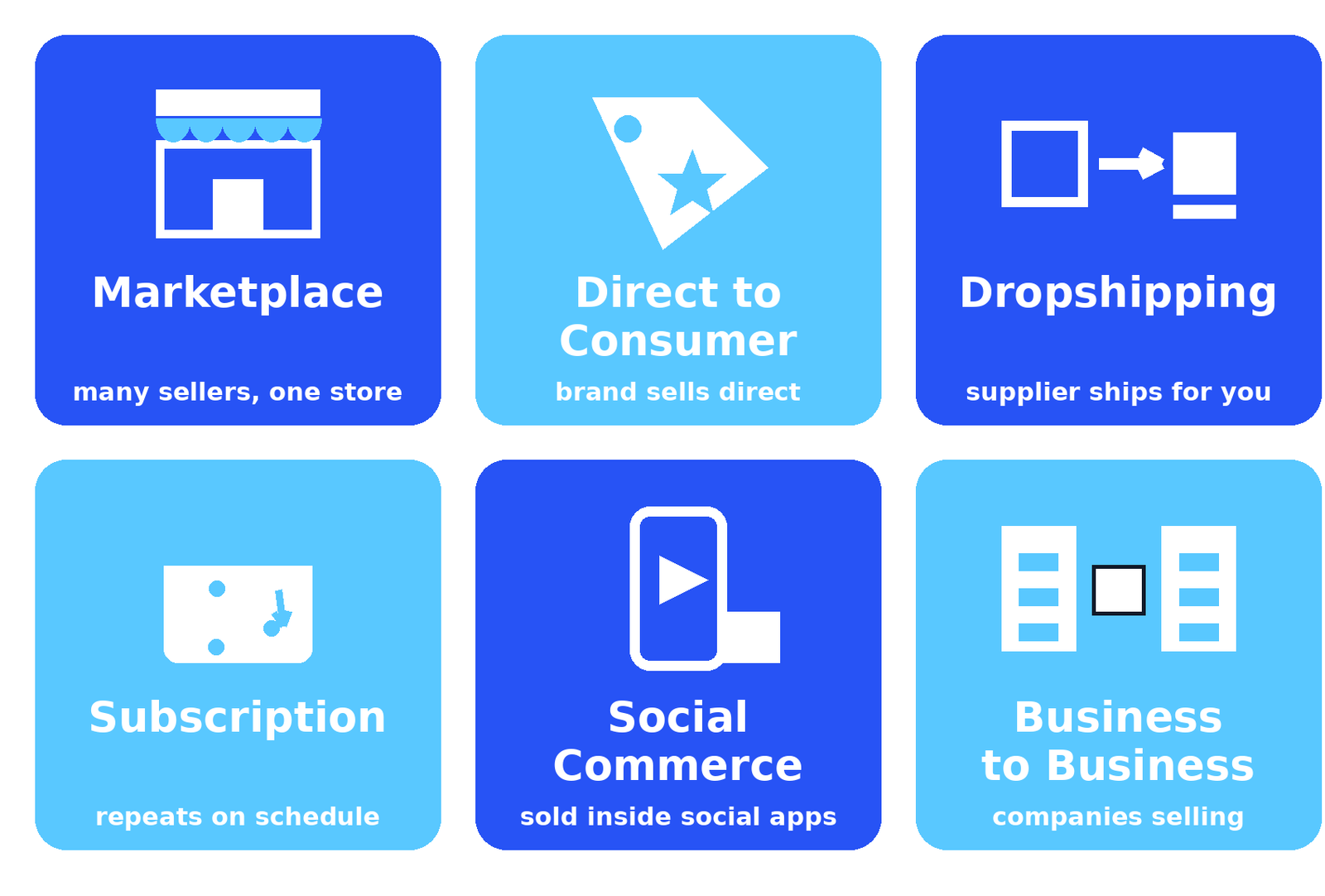
| Model | How it makes money | Who holds the inventory | Who handles delivery | Margin shape | Startup difficulty | Example |
|---|---|---|---|---|---|---|
| Marketplace | Commission on each sale, plus seller fees, ads, and paid storage and delivery services | Mostly the sellers | Seller, or the marketplace for a fee | Thin per sale, huge volume | Very hard: needs buyers and sellers at the same time | Amazon Marketplace, Etsy |
| Direct-to-consumer brand | Full margin on its own products | The brand | The brand or its delivery partner | Widest per sale, but marketing eats a share | Medium | Gymshark |
| Dropshipping | Gap between the shop price and the supplier price | The supplier | The supplier | Thinnest per sale | Easiest to start | Small niche stores on Shopify |
| Subscription | Recurring charges every cycle | The company | The company or its delivery partner | Moderate and predictable | Medium | HelloFresh |
| Social commerce | Product margin minus platform commission; creators can earn commission too | The seller | The seller or the platform’s delivery service | Moderate, minus fees | Easy to start, hard to make repeatable | Sellers and creators on TikTok Shop |
| B2B ecommerce | Wholesale margin on bulk and repeat orders | The seller (brand or wholesaler) | Seller, buyer, or a freight partner | Lower per unit, large orders | Medium to hard | Alibaba.com, Faire |
Two lessons fall out of the table. First, hybrids are normal, not cheating. Amazon runs retail, marketplace, and subscription (Prime) income at once, and a D2C brand may add a marketplace listing or a subscription box once the basic model works. Second, the model decides your hardest job. Marketplaces fight to get both sides at once, D2C brands fight for traffic, dropshippers fight for trustworthy suppliers, and subscription companies fight to keep members.
Is Shopify an ecommerce company?
Shopify tops most “top ecommerce companies” lists, which confuses people, because Shopify is not a store. Shoppers cannot buy shoes or phones from Shopify. As its own site puts it, Shopify is the platform to build, run, and grow an online store. Merchants pay Shopify for the storefront software, the checkout, and related services. The stores built on it are the ecommerce companies. Shopify is one of their suppliers.
The same is true of WooCommerce, the open-source ecommerce platform for WordPress. It provides the shop machinery, while the business using it provides the products, the stock, and the customers. Keeping this line clear matters when you read rankings: platform companies sell the shelves, ecommerce companies sell what sits on them.
Anatomy of an ecommerce company: the stack
Strip away the branding and every ecommerce company, from a one-person store to a giant, runs on the same six layers. Real tools exist for each layer, and the examples below were checked on the providers’ own sites. Storefronts come from hosted platforms such as Shopify or from open-source software such as WooCommerce. Cards and wallets run through payment processors such as Stripe, which describes itself as payments and financial infrastructure for online business. Stock is tracked in inventory software such as Zoho Inventory. Parcels are packed in-house at first, then handed to fulfilment companies such as ShipBob, which covers warehousing, shipping, and returns processing. Customers are brought back with email and text tools such as Klaviyo, built for ecommerce marketing. And questions land in a helpdesk such as Gorgias, a support platform made for ecommerce brands.
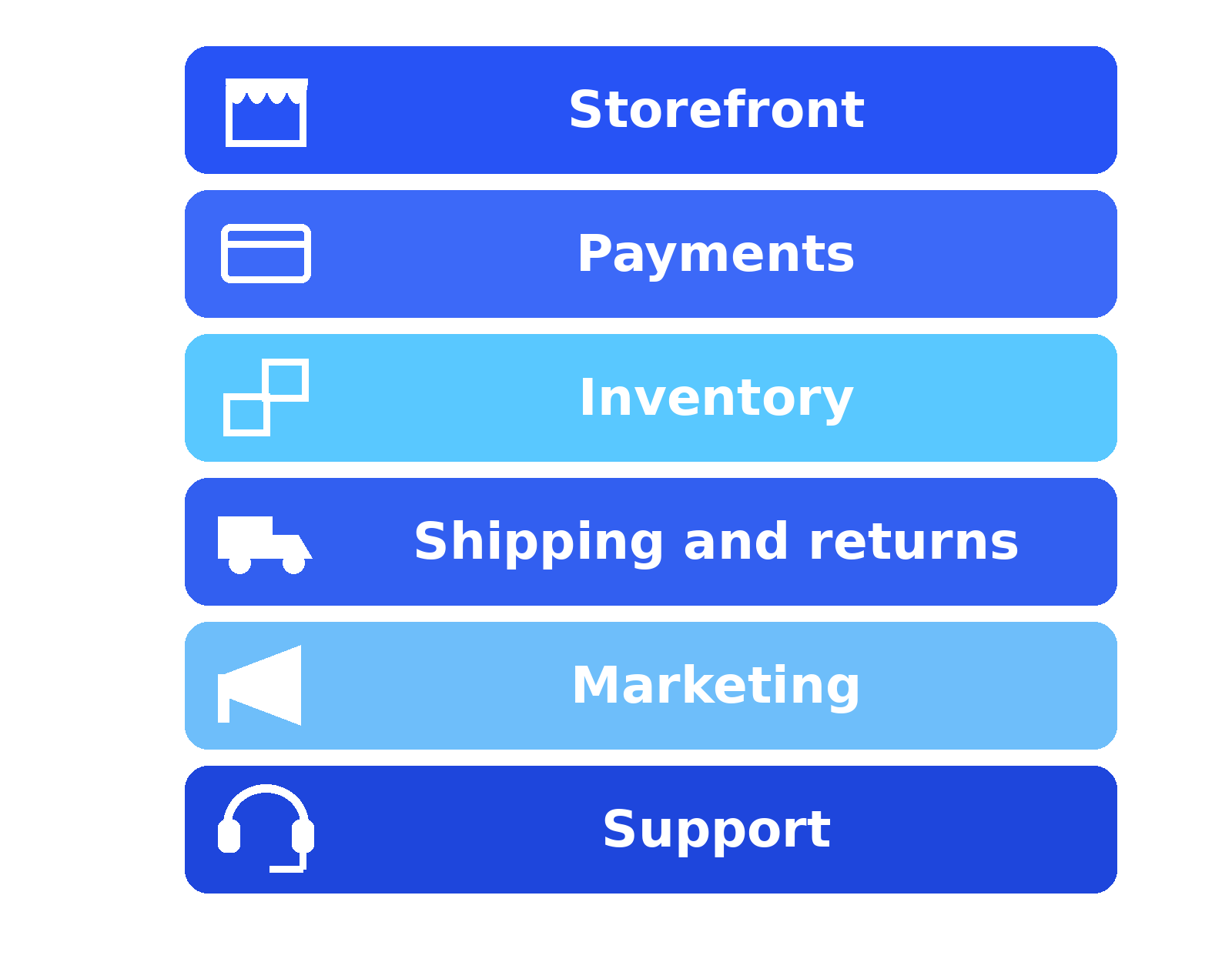
| Layer | The job it does | Tools and services that do it |
|---|---|---|
| Storefront | Where shoppers browse, fill a cart, and check out | Hosted platforms (Shopify) or open-source software on your own site (WooCommerce) |
| Payments | Takes cards and wallets, checks for fraud, and pays the money into your account | Payment processors such as Stripe and PayPal |
| Inventory | Tracks stock across your store, marketplaces, and warehouse, so you never sell what you do not have | Inventory software such as Zoho Inventory; built-in stock tools while you are small |
| Shipping and returns | Picks, packs, and posts each order, then handles the items that come back | Your own packing bench at first; fulfilment companies such as ShipBob as volume grows |
| Marketing | Brings new shoppers in and brings past buyers back | Email and SMS tools such as Klaviyo, plus search and social ads and your own social channels |
| Support | Answers “where is my order”, fixes problems, and protects your reviews | Helpdesks built for ecommerce such as Gorgias, or a general helpdesk such as Zendesk |
One practical note: the layers pass data to each other all day, and small format fixes are part of the job, from cleaning a supplier spreadsheet to decoding a data file from a sales channel. Our free converter tools handle the common text and number conversions in the browser, with no sign-up.
Your first 90 days
If you are starting an ecommerce company, this sequence keeps the six layers in the right order. It assumes a simple model, one product range, and one sales channel to begin with.
Days 1 to 30: set up
- ☐ Pick ONE model and one product range. Write down who the customer is and why they buy.
- ☐ Register the business and sort the tax basics for where you sell.
- ☐ Choose the storefront and connect payments, then place a real small test order yourself.
- ☐ Write the shipping and returns policies before the first sale, and state delivery promises in business days, the same count your courier uses.
- ☐ List the first products with honest photos, clear sizes and specs, and real prices including delivery.
Days 31 to 60: first sales
- ☐ Launch quietly to a small audience first, and watch every checkout for friction.
- ☐ Set up one support inbox and save reply templates for the five questions every store gets.
- ☐ Start one marketing channel properly: an email list with a welcome offer, plus one social channel you can keep up.
- ☐ Check stock against sales every week, so a bestseller never silently runs out.
Days 61 to 90: fix and grow
- ☐ Review which products actually sell, and cut or fix the rest.
- ☐ Speed up your slowest layer. For most young stores it is shipping times or slow support replies.
- ☐ Add a second channel only if the first one works, for example a marketplace listing or TikTok Shop.
- ☐ Set a weekly numbers habit: orders, refunds, delivery times, and repeat buyers.
4 mistakes that sink new ecommerce companies
- Copying a giant’s model at small scale. Amazon can run thin margins on huge volume. A new store cannot, and pricing like it can is the fastest route to running out of cash.
- Counting revenue before the deductions. Fees, delivery, packaging, and returns all come off the sale price. The margin that matters is what is left after all four.
- Treating returns as an afterthought. In online selling, returns are a normal cost of the model, not bad luck. Stores that hide the returns policy lose trust and still get the returns.
- Promising delivery in calendar days. Couriers count working days, so a “3 day” promise made on Friday can mean Wednesday. Say it the way the courier counts it.
None of the six models is the “best” one in general. The right model is the one that matches what you sell, how much stock you can afford to hold, and where your customers already spend their time. Pick that one, build the six layers in order, and the company has a fair chance of still being here next year.
Frequently asked questions
What is an ecommerce company in simple terms?
It is a business that sells products or services over the internet. The shopper browses, orders, and pays online. The goods can be physical parcels, digital downloads, or services, and the company can be a giant marketplace or one person with a store.
What is the difference between a marketplace and an online store?
An online store belongs to one seller, who owns the stock and sets the prices. A marketplace is a shared platform where many sellers list their own products, and the platform takes a cut of each sale for providing the shop window, the traffic, and usually the checkout.
Is Shopify an ecommerce company?
Not in the way most people mean it. Shopify sells no products to shoppers. It rents the storefront, checkout, and tools to the businesses that do sell, and those businesses are the ecommerce companies. Shopify is a platform company, and lists that rank it as a store are mixing up two different jobs.
How do ecommerce companies make money?
It depends on the model. Stores and brands keep the margin between the price and their costs. Marketplaces take a commission on other people’s sales, plus fees and advertising. Dropshippers keep the gap between the shop price and the supplier price, and subscription companies collect a repeating charge every cycle.
What do you need to start an ecommerce company?
A product or service people want, one clear model, and the six layers in this guide: a storefront, a way to take payments, stock tracking, shipping and returns, marketing, and support. Most people start with a hosted storefront, one payment processor, and their own packing bench, then add tools as orders grow.
Sources
- ClickPost: Top ecommerce companies (definition of an ecommerce company)
- Straits Times (AFP): Amazon, from online book seller to market shaker (founded 1994, Marketplace launched 2000)
- Business Model Analyst: Gymshark business model (founded 2012, direct-to-consumer)
- HelloFresh UK: FAQs (meal kit delivery service, flexible subscription)
- Hootsuite Blog: How to sell on TikTok (TikTok Shop, selling inside the app)
- Faire (official site): Online wholesale marketplace for retailers and brands
- Shopify (official site): all-in-one commerce platform to build, run, and grow an online store
- Shopify UK Blog: Top ecommerce companies list and guide
- WordPress.org: WooCommerce, the open-source ecommerce platform for WordPress
- Stripe: Payments and financial infrastructure (official)
- Zoho Inventory Knowledge Base: List of features (stock and order management)
- ShipBob: Outsourced fulfillment services guide (warehousing, shipping, returns processing)
- Klaviyo (official site): email and SMS marketing platform built for ecommerce
- Gorgias Docs: Create a Gorgias helpdesk (customer support platform for ecommerce brands)
- Hostinger Tutorials: Types of eCommerce business models

Jimmy
Jimmy is the editor behind TechyHunt. He covers business software, cybersecurity and practical tech how-tos, and leads testing for the site's free converter tools. His focus is clear, jargon-free guides that help readers make smarter tech decisions, faster.
Every article follows our Editorial Standards. Spotted an error? Tell us.