
On this page
- What is DevOps consulting?
- What DevOps consulting companies actually do
- The four types of DevOps consulting company
- Engagement models: how the deal is shaped
- How an engagement usually runs
- How to choose a DevOps consulting company
- Red flags to walk away from
- What it costs, in general terms
- The bottom line
- Frequently asked questions
- What does a DevOps consulting company do?
- What is the difference between DevOps consulting and managed DevOps services?
- How long does a DevOps consulting engagement take?
- Should we hire a global consultancy or a small specialist firm?
- What should be in a DevOps consulting contract?
Quick answer: A DevOps consulting company is an outside firm you hire to fix how your software gets built, tested, and released. Its engineers study your current setup, then design and build the automated pipelines, cloud infrastructure, and monitoring your team needs. Good firms also train your team and hand over full documentation, so you are not dependent on them forever.
Search this term and you will find page after page of ranked lists. Most are written by the firms themselves, with scores and ratings that nobody independent has checked. This guide takes a different route. It explains what these companies actually do, the types of firm you will meet, how engagements are structured, and how to choose one with a scorecard you can copy. No firm is ranked here, and no rating is invented.
What is DevOps consulting?
DevOps is a way of working where the people who write software (development) and the people who run it (operations) work as one team, with automation between them. The goal is simple: release changes often, in small steps, with tests and safety checks built in, instead of rare, large, risky launches.
DevOps consulting is what happens when a company brings in outside specialists to set that up, or to fix it when it breaks down. The consultants are senior engineers and architects who have built delivery systems many times before. They work on your systems, with your team, for a set period.
It is not the same as hiring one contractor for one task, and it is not the same as outsourcing your whole IT department. A consulting engagement has a defined problem, a defined set of deliverables, and an end point where the knowledge stays with your team.
What DevOps consulting companies actually do
Service menus differ from firm to firm, but the core work falls into six areas. The table below is the useful version: for each service, the problem it solves, what you should receive, and the shape the engagement usually takes. If a proposal you receive cannot be matched against rows like these, ask what exactly you are paying for.
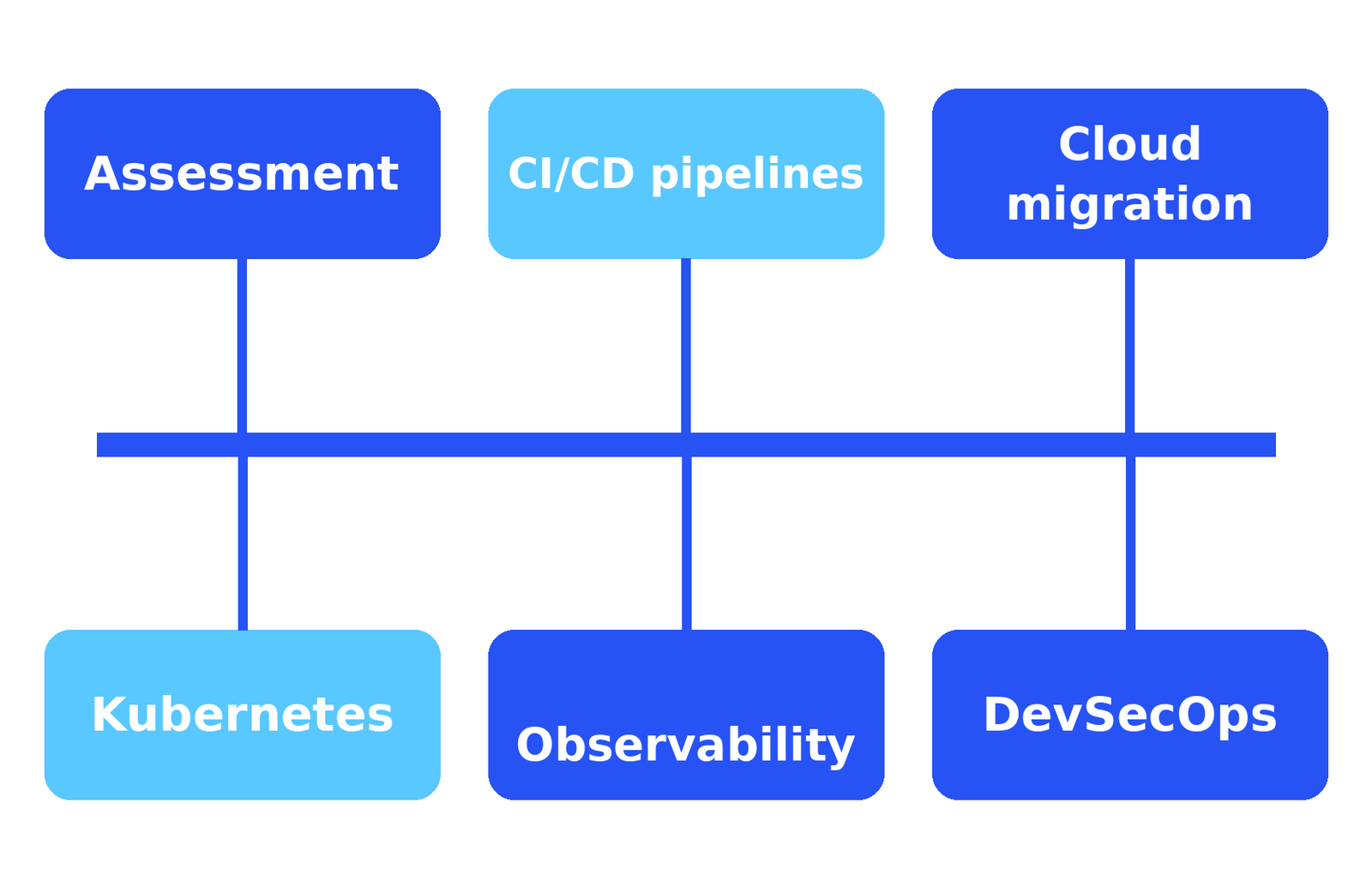
| Service | The problem it solves | The usual deliverable | Typical engagement shape |
|---|---|---|---|
| DevOps assessment and roadmap | Releases are slow or keep failing, and nobody can say why | A written report on your current build, test, and release path, with the bottlenecks named and a step-by-step plan | Short fixed-scope project, usually a few weeks |
| CI/CD pipeline build | Every release is manual, slow, and different each time | A working automated pipeline that builds, tests, and deploys code the same way every time, with a rollback path | Fixed-scope project, then handover |
| Cloud migration | Servers in a data centre are costly, ageing, or hard to scale | Your workloads moved to a cloud platform, with the new environment built as code and tested before the switch | Phased project, often the largest single engagement |
| Kubernetes and platform engineering | Containers and clusters have grown messy, and developers wait on operations for simple tasks | A managed cluster setup, or an internal platform where teams can deploy on their own inside set guardrails | Project to build, often followed by an ongoing support retainer |
| Observability and reliability (SRE) | Outages are found by customers first, and nobody knows which alerts matter | Monitoring, logging, and alerting set up around the signals that matter, plus incident routines your team can follow | Project to set up, often ongoing as a managed service |
| DevSecOps and compliance | Security checks happen late, or block releases, or get skipped | Security scanning and policy checks built into the pipeline, with audit records your compliance team can use | Project, often tied to a compliance deadline |
Two things cut across all six rows. The first is infrastructure as code: the servers, networks, and settings are written as code files, so an environment can be rebuilt or reviewed like software. The second is knowledge transfer: the firm should leave your team able to run what it built. Both belong in the contract, not just in the sales call.
Read every proposal against this table. A serious proposal names the rows it covers, the deliverable for each one, and the order they happen in. A weak one talks about transformation in general words and never lands on anything you can hold. If a firm wants to skip the assessment row and jump straight to a long build, it is guessing with your money.
The four types of DevOps consulting company
Firms that sell DevOps consulting come in four broad types. The type matters more than the brand name, because it decides who actually does the work, and what the firm is quietly set up to favour.
Global consultancies. Large firms such as Accenture sell DevOps as one part of a much wider technology and outsourcing business; its own site presents cloud and infrastructure managed services as part of that range. These firms suit big, regulated companies that need many engineers, coverage in several countries, and formal governance. The trade-off is cost and distance: the people who win the deal are rarely the people who do the work, and a small project can get lost inside a big firm.
Cloud provider consulting arms. Each big cloud runs its own consulting team. AWS describes AWS Professional Services as its team that helps organisations design, build, migrate, and manage workloads on AWS, and Google runs the same idea as Google Cloud Consulting. These teams know their own platform deeply, and they are a strong fit when you have already chosen that cloud. The limit is built in: their advice points at their own platform, so do not ask them whether a rival cloud fits you better.
Cloud partner firms and specialist boutiques. Below the giants sit firms that live on one cloud or one skill. nClouds, for example, presents itself on its own site as an AWS Premier Tier Services Partner whose work covers cloud modernisation, DevOps, and managed services. Boutiques like this are usually smaller, more senior per person, and faster to start. The risk sits the other way: check that they can cover you when a key engineer is away, and that they will still be around in two years.
Staff augmentation firms. These firms do not sell a project at all. They sell people. BairesDev, for instance, describes its staff augmentation service as adding its engineers to your in-house team, under your direction. That model works when you know exactly what to build and simply lack hands. It is not consulting: the thinking, the planning, and the quality control stay with you.
Engagement models: how the deal is shaped
Whichever type you choose, the deal usually takes one of four shapes.
Fixed-scope project. A defined outcome, such as an assessment or a pipeline build, for an agreed scope and timeline. This is the safest first step with a new firm, because both sides can judge the result before committing to more.
Time and materials. You pay for the engineers’ time while the work stays flexible. This suits problems whose true size is unclear, but it needs weekly reporting and a spending cap, or the bill drifts.
Managed DevOps, or DevOps as a service. The firm runs your pipelines, cloud platform, and monitoring on an ongoing basis, against a service level agreement (SLA). You get a DevOps function without hiring one. Read the SLA closely: it should name response times, support hours, and who owns an incident at 2 a.m.
Embedded team, or staff augmentation. Their engineers join your team and your daily routines. This is fast to start, and knowledge spreads naturally, but you manage the work day to day.
In practice, many engagements mix two shapes: a fixed-scope assessment first, then a build, then a managed service or a smaller embedded team to run things while your own hiring catches up. Mixing is normal. What matters is that each stage has its own written scope, so one open-ended deal never quietly swallows the whole budget.
How an engagement usually runs
A healthy engagement has three stages, whatever the model. First comes discovery. The firm studies your code path, your cloud setup, your release history, and your team’s habits, usually over the first few weeks. Treat any firm that skips this stage and quotes a full transformation on day one as a warning sign.
Second is the build, done alongside your team rather than behind closed doors. Your engineers join the work, review the code, and learn the new system as it takes shape.
Third is handover: documentation, runbooks, training sessions, and a period where your team runs the system while the consultants watch. The plan for all three stages should come with dates. Project timelines are normally quoted in business days, so check the firm’s holiday calendar before you agree a deadline, because a milestone that looks three weeks away can move when holidays land inside it.
How to choose a DevOps consulting company
You cannot judge a DevOps firm the way the ranked lists do, by logos and star ratings. Judge it on evidence you can check. Start with fit: a firm whose case studies match your size, your cloud, and your industry will need less time to understand your problems. Then work through the scorecard below with every firm on your shortlist. Score each point yes, partly, or no, and ask for proof, not promises, on the ones that matter most: who does the work, what you own at the end, and how you leave.

The 12-point vendor selection scorecard (copy and use):
- They hold current certifications or partner status on your cloud, and can name the certified engineers.
- They show case studies from companies of your size, not only giant brands.
- They name the actual engineers who will do the work, and you can interview them.
- A discovery or assessment phase comes before any big build quote.
- They build on the tools you already pay for, where those tools are sound.
- Deliverables are listed in writing, with dates, before you sign.
- Documentation and runbooks are named deliverables, not a favour at the end.
- A knowledge transfer plan exists: training, pairing, and a handover period.
- You own the code, scripts, and infrastructure templates they create for you.
- Everything is built inside your own cloud accounts, under your control, from day one.
- The SLA names response times, support hours, and how incidents are escalated.
- Exit terms are clear: notice period, what they hand over, and no penalty for leaving with your own systems.
Score each firm on the same sheet and compare the totals. Where two firms tie, pick the one that scored better on points 3, 8, and 12. Those three decide how the engagement feels when something goes wrong, and how it ends.
Two checks sit outside the sheet. Ask for reference clients you can actually call, and ask each one the same question: what did the firm hand over at the end, and could your team run it alone? And if the firm resists a small, paid first step, such as the assessment on its own, ask yourself why it needs the whole deal signed before it has seen your systems.
Red flags to walk away from
Slow down, or walk away, when you see these:
- No discovery phase, and a full solution quoted from one sales call
- The pitch leads with tools you should buy, not problems to solve
- They cannot say who will actually do the work
- Vague pricing that cannot be tied to named deliverables
- No documentation or training in the plan, so you stay dependent on them
- Everything will live in their accounts, or on their own platform
- They agree with every idea you raise and never push back
- Exit terms are missing, or leaving means rebuilding from scratch
What it costs, in general terms
What will it cost? Any exact figure printed in an article like this one would be invented, because the price depends on the firm’s country, the seniority of its engineers, and the size of the problem it is fixing. Firms also guard their rate cards, so treat precise prices in ranked lists as marketing.
What you can pin down is the shape of the cost. Assessments are usually small fixed-fee projects. Builds are priced by scope, or by team and month. Managed services are a monthly fee tied to the size of the platform and the cover hours. Staff augmentation is a monthly rate per engineer.
Protect yourself the same way in every model: tie payments to deliverables you can check, keep the first engagement small, and make sure the contract says the pipelines, scripts, and documentation are yours. A firm that is confident in its work does not need to lock you in to keep you.
The bottom line
DevOps consulting works when it leaves you faster, and less dependent, than it found you. Choose the type of firm that fits your size, start with a small fixed-scope engagement, and judge the firm on the scorecard, not on the sales deck.
One practical note while you compare proposals: vendor documents and config samples arrive in every format going, and small jobs like converting a config file between formats come up again and again. Our free converter tools run in the browser and handle those in seconds, with no sign-up.
Frequently asked questions
What does a DevOps consulting company do?
It studies how your software is built, tested, and released, finds where that path is slow or risky, and then designs and builds the fix: automated CI/CD pipelines, cloud infrastructure written as code, monitoring, and security checks inside the pipeline. A good engagement ends with your own team trained and documented, able to run the system without the consultants.
What is the difference between DevOps consulting and managed DevOps services?
Consulting is project-shaped: a defined problem, a build, and a handover. Managed DevOps is ongoing: the firm runs your pipelines, platform, and monitoring month after month, against an SLA. Many companies start with a consulting project to build the system, then choose whether their own team or a managed service runs it.
How long does a DevOps consulting engagement take?
The shapes differ more than the dates. An assessment usually takes a few weeks. A pipeline or migration project usually runs for a few months. Managed services and embedded teams run month to month, with no fixed end. Any firm should give you a staged plan, with milestones quoted in business days, before you sign, and a firm that promises a full transformation inside a couple of weeks is selling, not planning.
Should we hire a global consultancy or a small specialist firm?
Match the firm to your size and your problem. Global consultancies suit large, regulated, multi-country programmes. Specialist boutiques and cloud partner firms usually give smaller companies more senior attention and a faster start. Cloud provider consulting arms fit best when the cloud choice is already made. Use the scorecard in this guide on firms of any size.
What should be in a DevOps consulting contract?
Named deliverables with dates. The names or roles of the engineers doing the work. Documentation and training as deliverables in their own right. A clear statement that you own the code, scripts, and templates created for you. SLA terms for any ongoing support. And exit terms covering notice, handover, and your right to keep running everything they built.
Sources
- AWS Professional Services official page (AWS consulting arm: design, build, migrate, and manage AWS workloads)
- Google Cloud Consulting official page (Google Cloud's own consulting team, working alongside partners)
- Accenture official site, Cloud and Infrastructure Managed Services (global professional services firm)
- nClouds official site (AWS Premier Tier Services Partner: cloud modernisation, DevOps, managed services)
- BairesDev official site, IT Staff Augmentation Services (its engineers join the client's in-house team)

Jimmy
Jimmy is the editor behind TechyHunt. He covers business software, cybersecurity and practical tech how-tos, and leads testing for the site's free converter tools. His focus is clear, jargon-free guides that help readers make smarter tech decisions, faster.
Every article follows our Editorial Standards. Spotted an error? Tell us.