On this page
- Part 1: WFM meaning (workforce management)
- What WFM means
- What WFM covers
- A worked WFM example: staffing a 12-seat support team
- What happens without WFM
- WFM vs WFO vs HR software
- Part 2: What is a quote in business?
- What a business quote is
- What a good quote includes
- Sample quote (copy the layout)
- Quote vs estimate vs invoice vs proposal
- How long should a quote stay valid?
- Reading a quote you receive
- The confusables glossary: 9 terms in one table
- Putting both terms to work
- Frequently asked questions
- What does WFM stand for?
- What is the difference between WFM and WFO?
- Is a business quote legally binding?
- What is the difference between a quote and an estimate?
- How long is a quote valid for?
Quick answer: WFM means workforce management: forecasting how much work is coming, scheduling the right number of people to cover it, and tracking time, attendance, and leave. A quote in business is a document a seller sends before work starts, offering a set price for a set job. It is firmer than an estimate, and it is not an invoice, because no money is owed yet.
Business runs on short documents and shorter abbreviations. Two of the most common are WFM, which appears in software names and job posts, and the humble quote, which appears every time a client asks “how much will it cost?” This guide explains both in plain words, with a worked example for each.
Part 1: WFM meaning (workforce management)
What WFM means
WFM stands for workforce management. Wikipedia describes it as the process of getting the best productivity, skill, and engagement out of an organisation’s workforce. In plain words, it is how a business makes sure the right people are working at the right times, in the right numbers.
The ADP glossary puts it in operational terms: WFM covers forecasting demand, building schedules, time and attendance, absence and leave management, and compliance. Genesys uses the same core idea for service teams: forecast how many contacts are coming, schedule agents to match, and track attendance and performance.
WFM started in call centres, where being two people short at peak hour means long queues. It now shows up anywhere people work in shifts: support teams, retail stores, warehouses, clinics, and delivery operations.
What WFM covers
Four jobs sit at the centre of workforce management:
- Forecasting. Predict how much work is coming: calls, chats, orders, or footfall, by day and by hour. Most forecasts start from past volumes, then adjust for seasons, promotions, and known events.
- Scheduling. Turn the forecast into shifts. The aim is to match staffing to demand, busy at peaks, lean in quiet hours, while respecting contracts, rest rules, and staff availability.
- Time and attendance. Record who actually worked, when they started and finished, and whether the schedule was followed. This is the data payroll and most labour law checks depend on.
- Leave and absence. Plan holidays, sick leave, and training so cover stays safe. In WFM terms, planned time off is part of “shrinkage”, the share of paid time when staff are not available to do the main job.
Around those four sit supporting jobs: real-time adjustments during the day, overtime planning, and reporting on cost and service levels.
A worked WFM example: staffing a 12-seat support team
Definitions only go so far. Here is the maths a WFM analyst runs, on simple round numbers. A support team expects 300 contacts on Monday. Each contact takes 12 minutes of work on average.
| Step | Number | How it is worked out |
|---|---|---|
| Workload | 60 hours | 300 contacts × 12 minutes = 3,600 minutes = 60 hours |
| Staffed hours needed | 75 hours | Agents cannot be busy 100% of the time, so at 80% occupancy: 60 ÷ 0.80 = 75 |
| Scheduled hours needed | 94 hours | Breaks, training, and absence (shrinkage) take 20% of paid time: 75 ÷ 0.80 = 93.75, so about 94 |
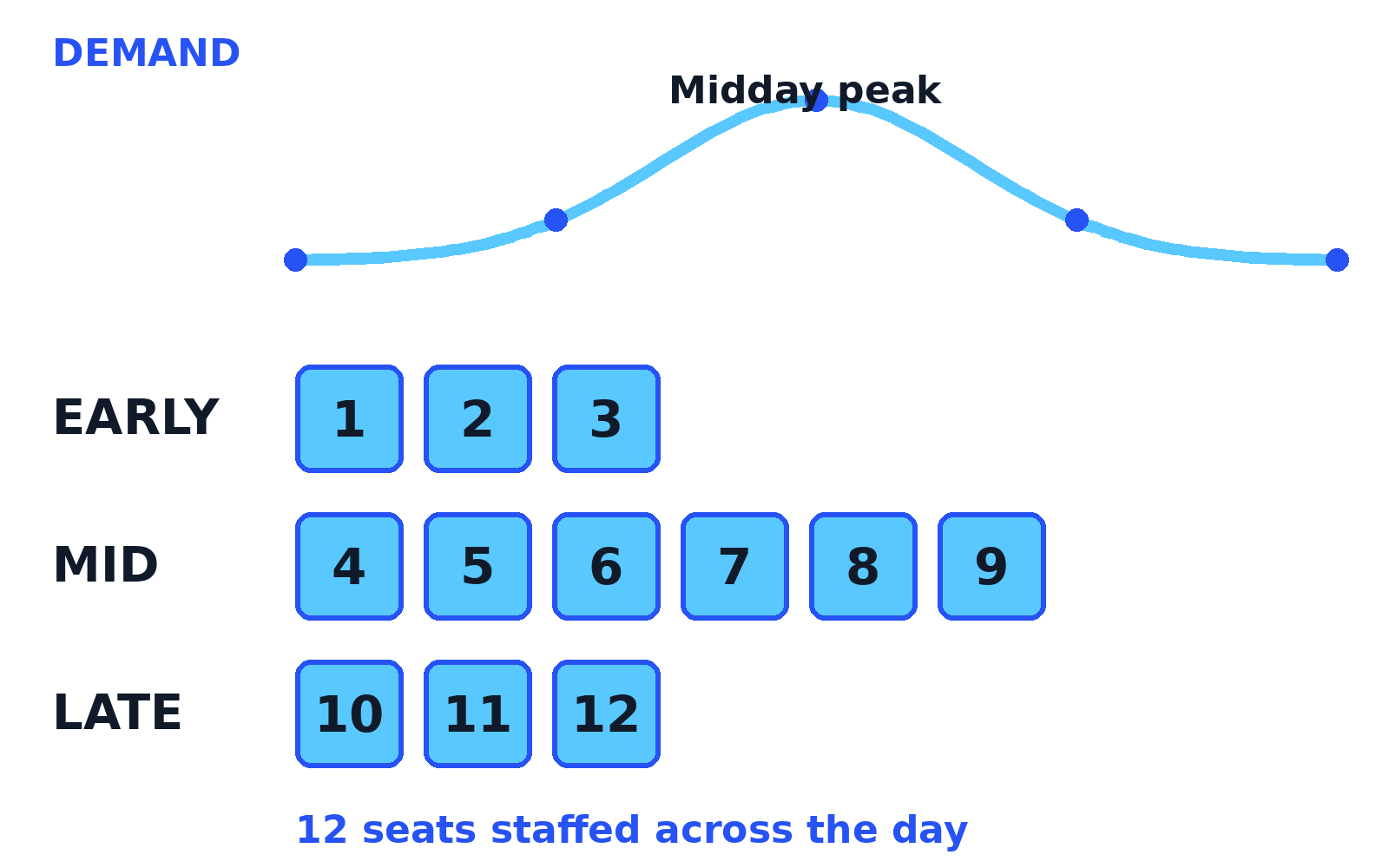
| Agents to schedule | 12 agents | 94 scheduled hours ÷ 8-hour shifts = 11.75, rounded up to 12 |
The team then spreads those 12 agents across the day: more on the morning and midday shifts when contacts peak, fewer in the evening. That is the whole WFM loop in miniature: forecast the work, convert it to hours, correct for real life, then place people where the demand is.
What happens without WFM
Teams that skip this maths usually fail in one of two directions. Overstaffing wastes money quietly: two extra agents on every quiet evening shift add up to hundreds of paid hours a year. Understaffing fails loudly: queues grow, customers give up, and the agents who are on shift burn out and leave, which makes the next rota even harder to fill. A spreadsheet can hold a rota, but it cannot warn you that next Monday needs 12 people while the Monday after needs 8. That warning is the job WFM exists to do.
WFM vs WFO vs HR software
Three labels get mixed up constantly:
| Term | What it focuses on | Typical extra features |
|---|---|---|
| WFM (workforce management) | Having the right number of people on shift: forecasting, scheduling, time and attendance | Shift planning, absence tracking, adherence reports |
| WFO (workforce optimization) | Everything in WFM, plus the quality of the work itself | Call recording, quality scoring, coaching, analytics |
| HR software / HRIS | The employee record: contracts, payroll data, onboarding, personal details | Personnel files, payroll, recruitment, performance reviews |
NICE draws the line this way: WFM focuses on forecasting demand and creating schedules, while WFO is the wider strategy that adds quality management, performance tracking, and training on top. TechTarget makes the same point: the two overlap on scheduling, but WFO platforms add tools such as call recording that aim to improve performance, not just coverage.
HR software is a different neighbour. An HRIS (human resource information system) is the database of record for employees. WFM tools often read from it (names, contracts, leave balances) but they answer a different question: not “who works here?” but “who is working on Tuesday at 10 a.m., and is that enough?”
Part 2: What is a quote in business?
What a business quote is
A quote, also called a quotation, is a document a seller sends to a possible buyer before any work starts. It states exactly what will be supplied and the price for it. Climb The Ladder defines a quotation as a fixed-price offer: the seller commits to the stated cost for the length of the validity period, as long as the scope of work does not change.
Two details make a quote different from a casual price mention. First, the price is meant to be firm, not a guess. Second, a quote has an expiry date, because costs change. If the buyer accepts the quote within its validity period, the accepted quote usually becomes the basis of the agreement between the two sides, which is why Emagia notes that a formally accepted quotation can be legally enforceable as an offer.
What a good quote includes
A clear quote carries the same building blocks almost everywhere:
- Both businesses’ details: names, addresses, and a contact person on each side.
- A quote number and date, so both sides can refer to the same document later.
- Itemised lines: each product or service on its own line, with quantity, unit price, and line total. One lump sum invites disputes.
- Subtotal, tax, and grand total, with a note on whether tax is included or added.
- A validity period, such as “valid for 30 days from the date of issue”.
- Terms: payment terms (for example, 50% deposit, balance on delivery), what is not included, and how long the work will take.
- How to accept: a signature line, or a simple “reply to this email to accept”.
Sample quote (copy the layout)
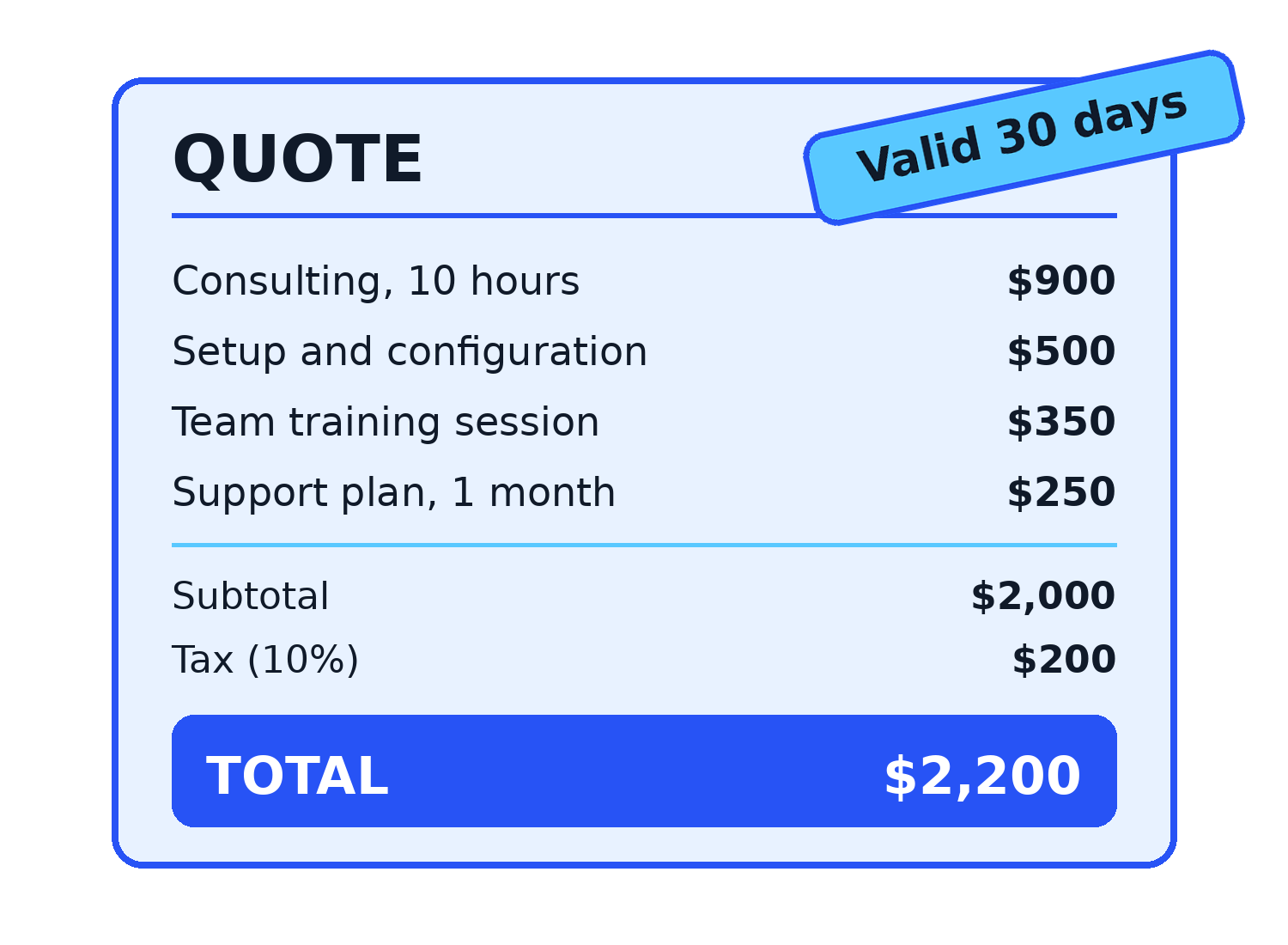
Here is a complete sample. The business and the numbers are made up for illustration, but the layout is the one real quotes use.
| From | Bright Pixel Studio (sample business) |
| To | Harbour Dental Clinic (sample client) |
| Quote number | Q-1042 |
| Date of issue | 5 January 2026 |
| Valid until | 4 February 2026 (30 days) |
| Item | Qty | Unit price | Line total |
|---|---|---|---|
| Website design, per page | 8 | $150 | $1,200 |
| Copywriting for the full site | 1 | $600 | $600 |
| Hosting and domain setup | 1 | $200 | $200 |
| Subtotal | $2,000 | ||
| Tax (10%) | $200 | ||
| Total | $2,200 |
Terms (sample): 50% deposit to start, balance due on launch. Price covers the items above only. Extra pages are quoted separately. Delivery within 15 business days of the deposit clearing (our guide to business days explains how that count works).
Quote vs estimate vs invoice vs proposal
These four documents travel together and get confused daily:
| Document | When it appears | Is the price firm? | What it asks for |
|---|---|---|---|
| Estimate | Early talks, scope still fuzzy | No, it is an approximation and the final price can move | Nothing yet, it opens the conversation |
| Quote | Before work, scope agreed | Yes, firm for the validity period | A yes or no decision |
| Proposal | Before work, bigger or competitive jobs | Often contains a quote inside it | A decision, based on the full case: solution, method, and price |
| Invoice | After work is done or a milestone is reached | It states the final amount owed | Payment |
The order matters. An estimate explores, a quote commits, a proposal persuades, and an invoice collects. PandaDoc sums up the quote versus invoice gap in one line of timing: a quote explains the cost before the customer accepts and buys, while an invoice can only be sent after the order has been fulfilled.
One more relative worth knowing is the pro forma invoice. It looks like an invoice and is sent after the buyer agrees but before delivery, often for customs or advance payment. It is not a demand for payment and is not a tax invoice in most countries.
How long should a quote stay valid?
Thirty days is the most common validity period, but shorter is normal when input prices move fast, and longer is fine for stable services. What matters is that the period is written on the document. An open-ended quote is a promise you may regret when your own costs rise. If you accept quotes from suppliers, note the expiry date the day the quote arrives, and treat an expired quote as a starting point for a fresh one, not a price you can still claim.
Reading a quote you receive
The same rules protect you as a buyer. Compare quotes line by line, not just by the total: a cheaper quote often drops an item the other one includes. Check whether tax is inside the total or added on top, because that alone can explain a price gap. Confirm the validity date is still open before you plan around the number. And when you accept, accept in writing, naming the quote number and date, so both sides are pointing at the same document if anything is disputed later.
The confusables glossary: 9 terms in one table
| Term | What it means, in one line | Example |
|---|---|---|
| Quote (quotation) | A firm, fixed price offered for a defined job, valid until a stated date | “We will build the 8-page site for $2,200, valid 30 days.” |
| Estimate | An approximate price given when the scope is not fully known; the final price can differ | “Repairs will cost roughly $800 to $950, depending on parts.” |
| Invoice | A bill sent after work is done or delivered, asking for payment | “Invoice 221: $2,200 due in 14 days for the completed site.” |
| Proposal | A sales document that sells a solution, its method, and its value, often with a quote inside | A 6-page document pitching a website redesign with timelines and case studies |
| Pro forma invoice | An invoice-shaped document sent before delivery, for customs or advance payment; not a tax invoice | An exporter sends one so the buyer can clear goods at customs |
| WFM (workforce management) | Forecasting work, scheduling people to match it, and tracking time and leave | Scheduling 12 support agents across shifts from a Monday contact forecast |
| WFO (workforce optimization) | WFM plus quality tools: recording, scoring, coaching, and analytics | Reviewing recorded calls and coaching the agents with the lowest scores |
| HRIS (human resource information system) | The central database of employee records: contracts, details, payroll data | Where HR stores each employee’s contract and leave balance |
| Scheduling software | A tool that builds and shares rotas and shifts; one part of WFM, not the whole of it | An app where staff see next week’s shifts and swap them |
Putting both terms to work
WFM and quotes meet in the same place: planning. A quote promises a client a price and a timeline. WFM is how you check whether your team can actually deliver that timeline before you sign. Businesses that quote first and plan later end up buying overtime. Businesses that run the forecast first quote prices they can keep.
And when the numbers land in a spreadsheet, small conversions come up constantly: hours to days, currencies, percentages. Our free converter tools handle those in the browser, with no sign-up.
Frequently asked questions
What does WFM stand for?
WFM stands for workforce management. It covers forecasting how much work is coming, scheduling the right number of people to cover it, and tracking time, attendance, and leave.
What is the difference between WFM and WFO?
WFM is about coverage: the right people on shift at the right times. WFO, workforce optimization, includes WFM and adds quality tools such as call recording, performance scoring, coaching, and analytics.
Is a business quote legally binding?
A quote on its own is an offer. Once the buyer formally accepts it, by signature, written confirmation, or a clear digital acceptance, the accepted quote usually becomes the basis of a contract, so treat every number on it as a commitment.
What is the difference between a quote and an estimate?
A quote gives a firm price for a defined job and holds it for a validity period. An estimate is an approximation used when the scope is still uncertain, and the final price can be higher or lower.
How long is a quote valid for?
As long as the document says. Thirty days is the most common period. If no validity period is written on a quote you receive, ask for one in writing before you rely on the price.
Sources
- Wikipedia: Workforce management
- ADP Glossary: Workforce management
- Genesys: What Is Workforce Management (WFM)?
- NICE: WFO vs WFM in Contact Centers
- TechTarget: What's the difference between WFM and WFO?
- Climb The Ladder: What Is a Quotation in Business? Definition and Legal Status
- Emagia: Invoice vs Quote (glossary)
- PandaDoc: Invoice vs Quote, Key Differences and How to Use Them
- The OmniBuzz: Invoice vs Estimate vs Quotation vs Proforma Invoice

Jimmy
Jimmy is the editor behind TechyHunt. He covers business software, cybersecurity and practical tech how-tos, and leads testing for the site's free converter tools. His focus is clear, jargon-free guides that help readers make smarter tech decisions, faster.
Every article follows our Editorial Standards. Spotted an error? Tell us.