
On this page
- What makes a coding language hard?
- The difficulty matrix
- The hardest languages, one by one
- Assembly: you are the computer’s assistant
- C++: everything C does, plus decades of extra machinery
- C: a small language with no safety net
- Rust: the compiler argues with you, for your own good
- Haskell: nothing is hard except thinking differently
- Why people still learn them: the payoff
- Which hard language fits your goal?
- The esoteric corner: languages designed to be hard
- The honest answer: hard depends on you
- Frequently asked questions
- What is the hardest coding language in the world?
- Is C++ harder than Rust?
- Is Python the easiest coding language to learn?
- Should a beginner start with a hard language?
- How long does it take to learn a hard language?
Quick answer: For languages people actually use at work, Assembly and C++ are the hardest to learn well. Both make you manage memory and machine details yourself, with little help when something goes wrong. Rust and Haskell are hard for different reasons: Rust fights you over memory rules, and Haskell makes you think in a completely new way. The hardest language of all is one nobody uses for work, designed to be nearly impossible. It sits in the fun section at the end.
Ask ten programmers which language is hardest and you get ten different answers, because “hard” mixes together several different problems. One language is hard to read. Another is easy to read but lets you break things in silence. A third reads fine but still forces your brain into a shape it does not like. This guide separates those problems, scores the main contenders on the same four tests, and gives the honest answer.
What makes a coding language hard?
Four things decide how hard a language feels. Every score in this article comes from these four tests, so you can argue with our numbers on the same rules.
1. Syntax readability. Can you guess what a line of code does just by reading it? Languages close to plain English score low here. Languages built from symbols, short codes, or strict punctuation score high, because you must learn the code before you can read it.
2. Memory management burden. Every program uses memory, and someone has to clean it up. In easy languages, a built-in garbage collector does it for you. In hard ones, you request memory and free it yourself, and if you forget, or free it twice, the program breaks in ways that are hard to trace.
3. New concepts to learn. Some languages work the way you already think: do this, then that, then check the result. Others ask you to learn a new way of thinking first, such as ownership rules, pure functions, or raw machine steps. The bigger the mindset shift, the higher the score.
4. Quality of error feedback. When something goes wrong, does the language tell you what broke and where? Good compilers explain the problem and suggest a fix. Weak feedback means the program crashes, prints nothing useful, or fails far from the line that caused it.
The difficulty matrix
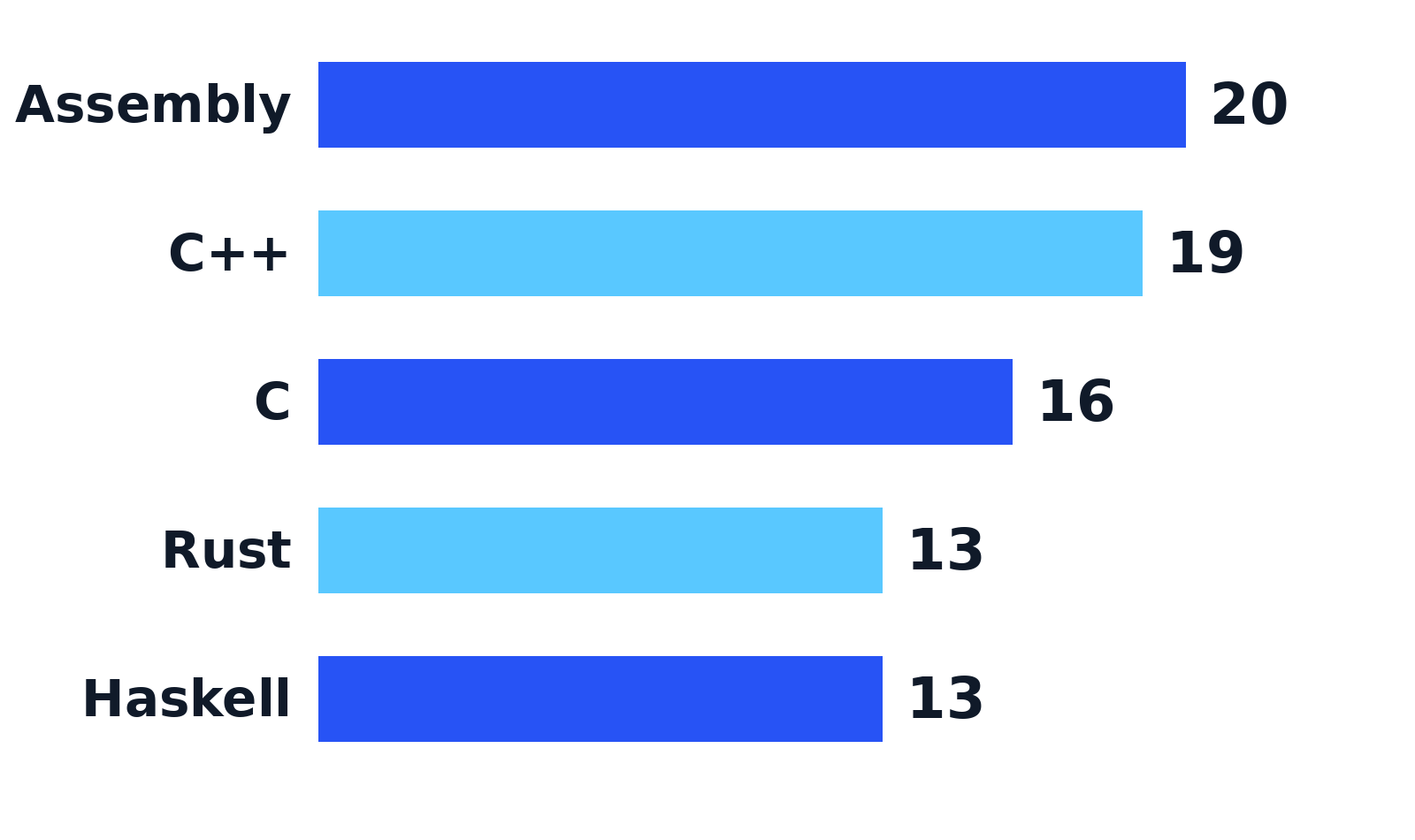
Scores run from 1 (easiest) to 5 (hardest) on each test. These are TechyHunt’s editorial scores, judged from the four criteria above. They are not survey results, and we do not dress them up as data. Your own scores may differ, and the last section explains why that is fine.
| Language | Syntax readability | Memory burden | New concepts | Error feedback | Total (of 20) | The hardest part |
|---|---|---|---|---|---|---|
| Assembly | 5 | 5 | 5 | 5 | 20 | You manage the machine itself, registers and all |
| C++ | 5 | 5 | 5 | 4 | 19 | A huge language where you control, and can break, everything |
| Brainfuck (esoteric) | 5 | 4 | 3 | 5 | 17 | Code is eight symbols, and you track every memory cell yourself |
| C | 3 | 5 | 3 | 5 | 16 | Pointers and manual memory, with almost no safety net |
| Rust | 3 | 4 | 4 | 2 | 13 | The borrow checker refuses code until the memory rules are right |
| Haskell | 3 | 1 | 5 | 4 | 13 | Unlearning variables, loops, and step-by-step thinking |
| Java | 3 | 1 | 3 | 3 | 10 | Verbose structure you must set up before anything runs |
| Python | 1 | 1 | 1 | 2 | 5 | Very little at the start, which is why it is the usual first language |
Two things stand out. First, the top of the table is all about memory and machine detail. The closer a language sits to the hardware, the more of the machine’s housekeeping lands on you. Second, Rust and Haskell tie on points but feel nothing alike. Rust is a strict inspector standing over familiar-looking code. Haskell quietly removes the tools you are used to, like changing variables and loops, and hands you a different toolbox.
One famous name is missing on purpose. Malbolge would score 5 on every test, because it was built that way. It gets its own section below.
The hardest languages, one by one
Assembly: you are the computer’s assistant
Assembly is not one language. It is a family of languages, one for each type of processor, and each is the thinnest possible layer over the machine’s own instructions. The short codes in assembly, called mnemonics, translate one to one into the commands that a specific CPU understands (Wikipedia: Assembly language).
That closeness is the whole problem. There are no helpful building blocks. You move values between registers, keep track of the stack, and manage memory addresses by hand. A five line Python program can take fifty lines here. And if you make a mistake, there is almost no feedback. The program simply does the wrong thing, or stops. Nothing is hidden from you, including every chance to get it wrong.
C++: everything C does, plus decades of extra machinery
Bjarne Stroustrup began building C++ at Bell Labs in 1979 as C with classes, and the first commercial release arrived in 1985 (Wikipedia: C++). Since then it has grown layer by layer: objects, templates, exceptions, and more, added standard by standard while keeping everything from earlier versions.
The result is the largest toolbox on this list, and the sharpest. You manage memory yourself, like C, and on top of that you must learn templates, operator overloading, and several programming styles in the same language. Two experts can write the same program in C++ and produce code the other finds hard to read. Error messages from template code are famous for running to pages of tangled text.
C: a small language with no safety net
C is older and smaller than C++. Dennis Ritchie developed it at Bell Laboratories, where it was implemented in 1972 as the language of the Unix operating system (History of C and C++). What makes it hard is not size. It is trust.
C trusts you completely. You work with pointers, variables that hold memory addresses, and you request and free memory by hand. If you point at the wrong address, C will not stop you. Many mistakes produce no error at all. The program runs, quietly damages something, and crashes later in a place that has nothing to do with the real fault. That silence is why C scores 5 for error feedback.
Rust: the compiler argues with you, for your own good
Rust began as a project by Graydon Hoare at Mozilla, and its first stable release, Rust 1.0, came out in May 2015 (Wikipedia: Rust). Rust promises the speed of C and C++ without their memory dangers, and it keeps that promise with a strict rule keeper called the borrow checker.
The rules are called ownership, and the Rust Book explains them plainly: every value has one owner, and when the owner goes out of scope, the value is cleaned up. You do not free memory by hand, and there is no garbage collector. Instead, the compiler checks every borrow of every value before the program may run. Code that would be a silent bug in C becomes a firm refusal in Rust. New Rust programmers often spend their first weeks fighting the borrow checker, then find the fights taught them the rules. Rust also earns the best error feedback score among the hard languages, because its compiler explains what rule you broke and often shows the fix.
Haskell: nothing is hard except thinking differently
Haskell first appeared in 1990, designed by a committee and named after the logician Haskell Curry (Wikipedia: Haskell). It is a purely functional language with strong, inferred types and lazy evaluation, which means values are only worked out when they are needed.
Nothing in Haskell asks you to manage memory, and its code can be short and clean. The difficulty is the mindset. There are no variables that change, and no loops in the usual sense. A function given the same input always returns the same output, and anything that touches the outside world is fenced off in a way that confuses newcomers. Programmers from C, Java, or Python backgrounds describe the same feeling: they are not learning new syntax, they are unlearning habits. That is why Haskell scores 5 for new concepts and only 1 for memory burden.
Why people still learn them: the payoff
Nobody climbs these hills for fun alone. Hard languages survive because each buys you something the easier ones cannot.
| Language | Why people still learn it | Where the skill pays off |
|---|---|---|
| C | It is the foundation under operating systems and countless other languages, and it teaches how computers really work | Operating systems, embedded devices, microcontrollers |
| C++ | Raw speed with full control over memory and hardware | Game engines, trading systems, browsers, high performance software |
| Rust | C-like speed with memory safety enforced before the program runs | Systems software, web infrastructure, command line tools, blockchain |
| Haskell | Code that is easier to prove correct, and a way of thinking that improves your code everywhere | Finance, compilers, research, correctness critical backends |
| Assembly | Total control of one specific processor, and nothing between you and the machine | Firmware, device drivers, reverse engineering, security research |
| Brainfuck and Malbolge | No job payoff at all. Bragging rights, and a strange new respect for normal languages | Puzzles, challenges, and talks at developer meetups |
Notice the pattern. The payoff is always control, speed, or correctness in places where a mistake is expensive: a game that must hold its frame rate, a trading system measured in microseconds, a bank ledger. Where the cost of failure is low, teams pick easier languages, and so should you.
Which hard language fits your goal?
Do not pick by difficulty ranking. Pick by destination.
- You want to build games or trading systems: learn C++. The engines and the low latency world run on it, and its difficulty is the entry price.
- You want modern systems work with a safety net: learn Rust. The early fight with the borrow checker pays you back on every project after.
- You want to understand how computers really work: learn C first, then read a little Assembly. C teaches the model, Assembly shows you the machine underneath it.
- You work in finance, or want to become a sharper thinker: learn Haskell. Even if you never ship it, the habits transfer to every other language you use.
- You just want a challenge this weekend: skip ahead to the esoteric corner.
The esoteric corner: languages designed to be hard
Everything above is hard as a side effect of its job. Esoteric languages are hard on purpose: jokes, puzzles, and art projects, and two of them own the top of every hardest language list ever written. If readable puzzles are more your speed, warm up with our Caesar cipher converter first. It fights back much less.
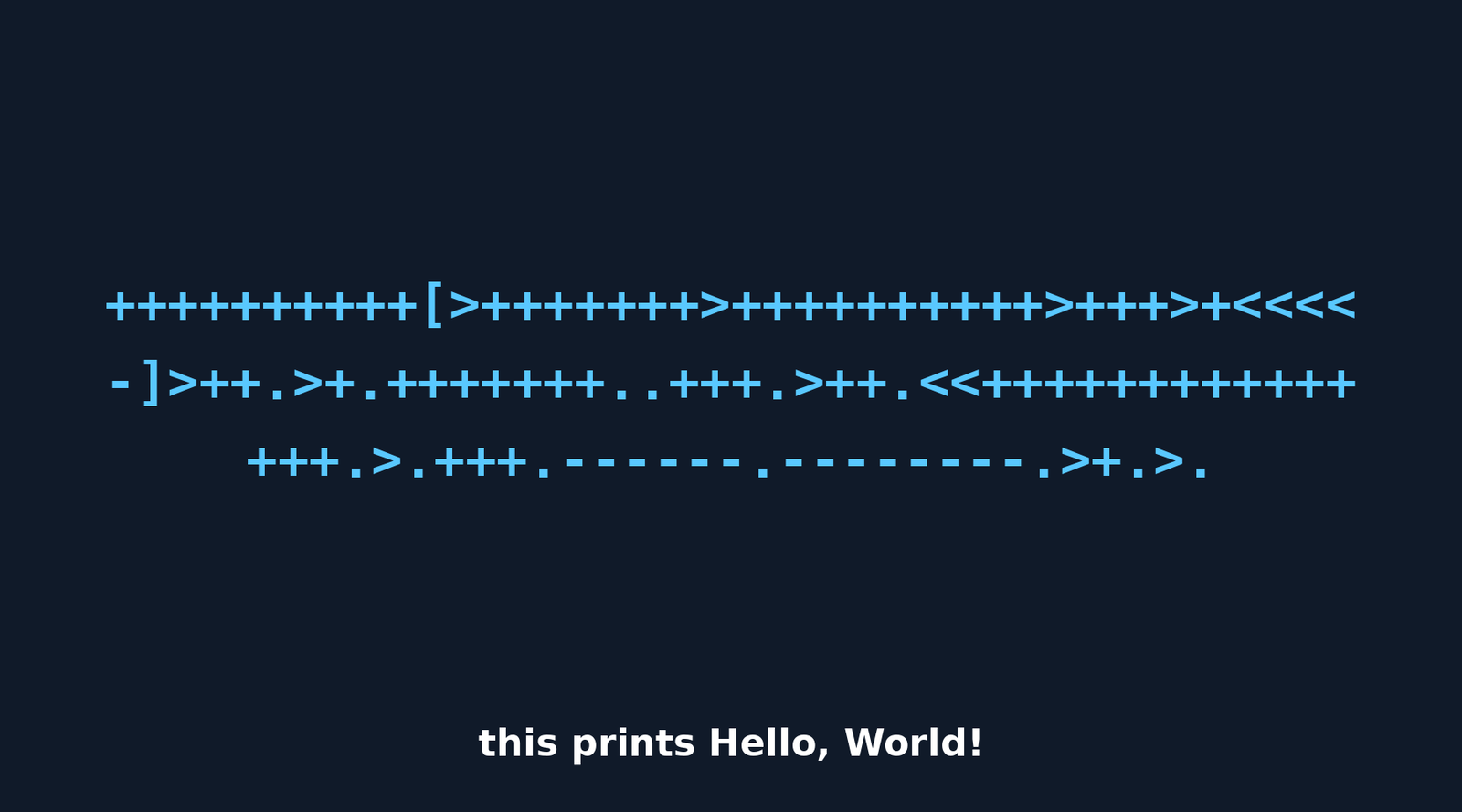
Brainfuck was created by Urban Müller in 1993 with one goal: the smallest possible compiler. The whole language has eight commands, each one character, and they work on a strip of memory cells, about 30,000 in the classic setup, with a pointer that moves along the strip (Hillel Wayne, A Brief Introduction to Esoteric Languages). There are no words or names. This is a complete Brainfuck program that prints “Hello, World!”:
++++++++++[>+++++++>++++++++++>+++>+<<<<-]>++.>+.+++++++..+++.>++.<<+++++++++++++++.>.+++.------.--------.>+.>.
Every character there is an instruction. Reading it tells you nothing, which is the point: it shows how little a language needs to still count as a language.
Malbolge took the joke to its limit. Ben Olmstead invented it in 1998 and named it after Malebolge, the eighth circle of Hell in Dante’s Inferno (Wikipedia: Malbolge). It uses base-three arithmetic instead of the usual binary, and the code alters itself as it runs, so the instruction you wrote is not always the instruction that executes. It was designed to be almost impossible to use, and it worked: the first Malbolge program appeared two years later, and even that one was not written by a human. A beam search algorithm built by Andrew Cooke generated it. Malbolge is the honest answer to “what is the hardest coding language in the world”, and it is useless for every real job in computing.
The honest answer: hard depends on you
Our matrix gives you a ranking. Now we will qualify it, because the ranking is only half the truth. Difficulty lives in the gap between a language and the person learning it.
Your background moves the rows. A programmer raised on C often finds Haskell baffling, because its rules ban the habits C taught. A maths graduate can feel the opposite: Haskell reads like the notation they already know, while C’s pointers feel like a trap. Neither person is wrong. They are measuring different gaps.
Your first language is always the hardest. A beginner who starts with C++ is not only learning C++. They are learning what programming is, using the least forgiving teacher available. An experienced developer learning their fifth language will find even Rust or Haskell easier than that beginner finds C++, because most concepts transfer and only the rules are new.
Your goal decides which hard matters. If you want to ship a small web app, every language on this list is the wrong kind of hard, and an easier one will get you there sooner. If you want to write a game engine, C++ stops being “the hardest language” and becomes simply “the language the work needs”. Pick the language whose difficulty buys the thing you want. That is the only ranking that will ever apply to you. And if you would rather stay on friendlier ground, our free converter tools will handle the small code and data puzzles while you decide.
Frequently asked questions
What is the hardest coding language in the world?
Malbolge, and it is not close. It was designed in 1998 to be almost impossible to program, with self-altering code and base-three arithmetic, and the first program in it took two years to appear. Among languages used for real work, Assembly and C++ are the hardest to learn well, topping our criteria matrix at 20 and 19 points out of 20.
Is C++ harder than Rust?
In our scoring, yes, 19 points against 13, but they are hard in different ways. C++ gives you full control and trusts you, so your mistakes can hide and surface later. Rust restricts you up front through the borrow checker, so the struggle happens early, in the open, with a compiler that explains itself. Many learners find Rust harder in the first month and C++ harder in the first year.
Is Python the easiest coding language to learn?
For most beginners, yes. Its syntax reads close to English, memory is managed for you, and errors are reported in plain terms. It scores 5 out of 20 in our matrix, the lowest here. That is why it is the standard first language, and why the hard languages in this guide are best judged against it.
Should a beginner start with a hard language?
You can, and plenty do. C is still a common first language in universities. Just expect slower early progress, because you are learning programming itself through a stricter teacher. If your goal is a job or a project soon, start with an easier language and add a hard one later. If your goal is deep understanding, starting hard is a fair trade.
How long does it take to learn a hard language?
Plan in stages. The basic syntax of C or Rust can be read in a few weeks of steady study. Feeling comfortable enough to build real projects takes months of practice. Feeling expert takes years, as it does in any language. These are rough stages, not promises: your pace depends on the hours you put in and on how much of your background transfers.
Sources
- The Rust Programming Language (The Rust Book): What Is Ownership?
- Wikipedia: C++ (Stroustrup, Bell Labs, work from 1979, first commercial release 1985)
- Wikipedia: Rust (programming language) (Graydon Hoare, Mozilla, Rust 1.0 on 15 May 2015)
- Wikipedia: Haskell (first appeared 1990, purely functional, lazy, strong inferred types)
- Wikipedia: Assembly language (mnemonics map one to one to CPU instructions)
- Wikipedia: Malbolge (Ben Olmstead, 1998, named after Malebolge in Dante's Inferno, self-altering code, base-three arithmetic)
- History of C and C++ (Deitel, Introduction to Computers, the Internet and the World Wide Web): C implemented by Dennis Ritchie at Bell Labs in 1972
- Hillel Wayne: A Brief Introduction to Esoteric Languages (Brainfuck, Urban Müller, 1993, eight commands)
- The Environmental Literacy Council: What is the hardest coding language to learn in the world? (SERP scan and cross-check)

Jimmy
Jimmy is the editor behind TechyHunt. He covers business software, cybersecurity and practical tech how-tos, and leads testing for the site's free converter tools. His focus is clear, jargon-free guides that help readers make smarter tech decisions, faster.
Every article follows our Editorial Standards. Spotted an error? Tell us.